
Overview (Eric)
Sudan’s countrywide catastrophe only deepens as conflict drives more and more civilians into intolerably insecure locations, and international efforts—diplomatic and humanitarian—are woefully inadequate at present to respond to this massive crisis. Fighting between the Sudan Armed Forces (SAF) and the Rapid Support Forces (RSF) has now dramatically intensified in the three Kordon states to the east and south of North Darfur, with no signs of de-escalation.
Much of the destructiveness of this conflict now derives from the increasing use of drones, which are ever more sophisticated and powerful. And the targeting of civilian and civilians structures is more and more frequently reported. Much attention was given, for example, to an RSF attack on the South Kordofan locality of Kalogi. The BBC reported more than 100 casualties; Al Jazeera gave a more precise figure and a grim account of just who the victims were:
RSF kills 116 people in Sudan’s Kalogi, including 46 children | Al Jazeera | December 5, 2025
Sudan’s Rapid Support Forces (RSF) have attacked a pre-school and other sites in the Kalogi locality of the state of South Kordofan, killing at least 116 people, according to a local official. The executive director of the Kalogi locality told Al Jazeera on Saturday that the victims of the attack included 46 children. Two military sources in the government-aligned Sudanese Armed Forces (SAF) also told Al Jazeera the RSF attacked the kindergarten on Thursday and later targeted civilians who had gathered to offer assistance amid the carnage. The city’s hospital and a government building were also bombed, the sources said.
Given the genocidal ambitions the RSF has demonstrated in their assaults on El Geneina, El Fasher, and many other locations overt the past 13 years—and the militia’s complete indifference to international human rights and humanitarian law—attacks like that on Kalogi do not come as a surprise, as shocking as they may be.
Notably, the drones deployed by the RSF come almost exclusively from the United Arab Emirates, led by the despotic Mohamed bin Zayed. And yet no Western country or consequential international actor has called him out for sustaining the conflict in Sudan by providing unlimited support in the form of sophisticated military equipment, vehicles for transport, communications gear, drones, and much else, including a secure base away from Sudan. Recent military successes have emboldened the RSF leadership, and continued fighting may well fracture the Sudanese.
The Trump administration has made what might appear to be sympathetic noises about Sudan—“the U.S. is “going to start working in Sudan,” November 19, 2025—but there has been no sign of Trump holding the UAE accountable, the critical starting point in ending Sudan’s war.
The pervasive insecurity that threatens many millions of Sudanese lives is most consequential in denying humanitarian organizations access to critical locations, and in precluding the movement of adequate supplies and personnel. Nowhere is this more true than in Darfur, and North Darfur in particular—where Team Zamzam is presently operating. More specifically, the Team works in the area of the cross-border town of Tina (Darfur)/Tiné (Chad). This is where a great many people leave Sudan to become refugees, but it is also the location—on both sides of the border—where many, many tens of thousands of people are in desperate need and simply do not have the wherewithal to flee further (the UN High Commission for Refugees is unable to move the growing population in Chad to the string of refugee camps lying some distance from the Chad/Darfur border).


And while the fact that the government of Chad considers Tiné an important town, one that the RSF might be hesitant to attack (if only because Chad allows the UAE to use its territory to move military supplies to the RSF inside Darfur), there is no guarantee that the people Team Zamzam is serving won’t be targeted. In fact, the RSF did mount a series of drone civilian attacks, culminating in an attack on Tina, that forced the temporary exit of Doctors Without Borders/Médecins Sans Frontières (MSF). In a post of November 6, MSF reported:
“Kornoi, Tine and Um Baru areas in North Darfur have experienced a sharp rise in drone attacks in recent days, causing many people to flee to Chad. In a horrifying attack a drone struck Kornoi Hospital on 3 November, killing and injuring several patients, including children and two pregnant women. MSF teams in Tine, Chad, have received 50 patients injured in drone strikes in this area of Sudan since 24 October 2025.
“MSF teams were also forced to withdraw temporarily because of these strikes. Teams are working to return to support healthcare facilities and help to ensure healthcare access, but repeated drone strikes make this challenging. ‘MSF is deeply concerned about the impact of drone strikes on civilians and humanitarian access and horrified that a hospital was hit.’”
(Dago Inagbe, MSF Coordinator for North Darfur)
[On December 8, the RSF launched another drone attack on an SAF army base near Tina.]
But there reports that the SAF is also engaged in military activities that work to limit in extreme ways humanitarian supplies. Ayin Network (winner of this year’s Dutch Human Rights Tulip Award) reported on December 1, 2025:
With the army and its allies intensifying the closure of the Tiné/[Tina] border crossing with Chad, coinciding with an emergency order issued by the governor of the Northern State banning the transport of goods to areas under Rapid Support Forces control in Kordofan and Darfur, millions of residents find themselves facing a suffocating economic war that directly threatens their food security.
Civilians are indeed caught in the middle, as is too often the case in this ghastly war, many of them acutely or severely malnourished, or injured, or suffering from exposure (it is the coldest time of year in this area)—or otherwise in urgent need of humanitarian assistance.
A month ago, in the wake of the fall of El Fasher, the International Organization for Migration put the matter bluntly:
Despite the rising need, humanitarian operations are now on the brink of collapse. Warehouses are nearly empty, aid convoys face significant insecurity, and access restrictions continue to prevent the delivery of sufficient aid. IOM is urgently appealing for increased funding and immediate, sustained and safe humanitarian access to avert an even ngreater catastrophe. (November 11, 2025)
Nothing has improved in the intervening month. In fact, since the RSF attack on and seizure of Zamzam IDP camp (with well over 500,000 residents) in April of this year and the genocidal assault on El Fasher (capital of North Darfur, with an estimated population of over 250,000 before that assault), we have lost any real understanding of where many hundreds of thousands of people are—or even whether they are alive. Many other locations in North Darfur have also seen civilians forced to flee RSF violence, and with no meaningful humanitarian or other reporting presence in the vast majority of this area, we are left truly blind to the enormity of displacement and destruction the RSF has wrought.


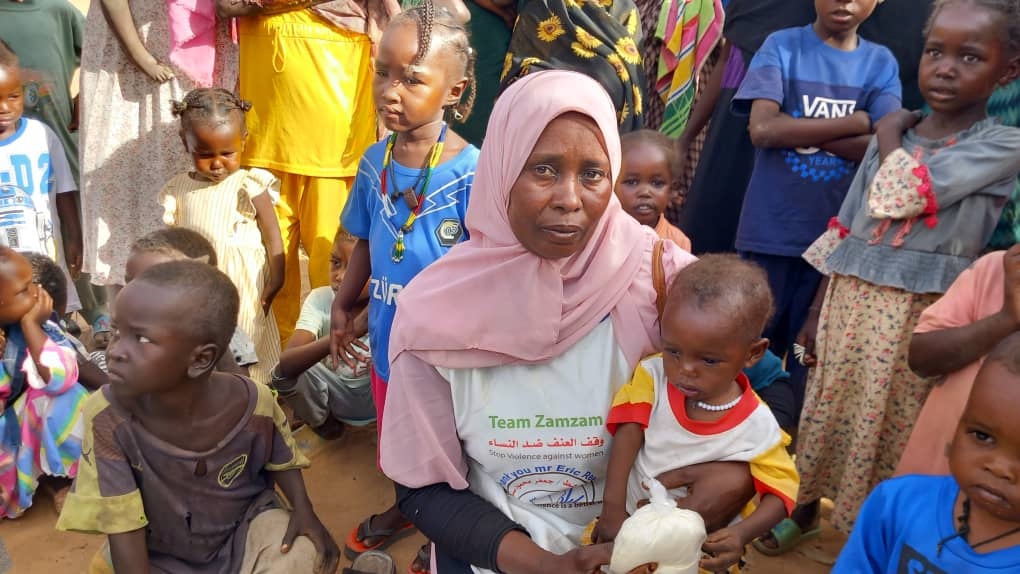
In the midst of this, Team Zamzam continues its extraordinarily dedicated, courageous, and compassionate work with the population that has fled to Tina/Tiné. At present—subject to security considerations—about 35% of their work is in Tina (Darfur) and 65% in Tiné (Chad). There work is more important than ever as UNHCR has recently released figures for the people who actually cross into Tiné and Chad; of particular note is the profile of these newly made refugees:
Women and children represent 87% of the population
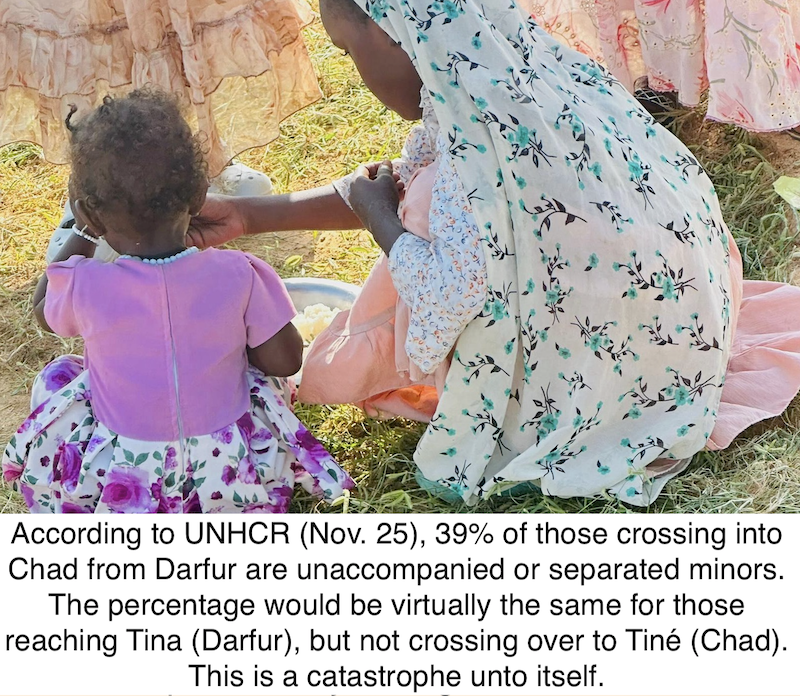
39% unaccompanied or separated minors
35% older adults
20% pregnant and lactating women
5% with gunshot wounds
(Overall, UNHCR reports that 169,283 Sudanese have been newly registered as refugees since January 2025)
The percentage of those arriving in Tina/Tiné as “unaccompanied or separated minors” is simply shocking, and works to explain why the focus of Team Zamzam, particularly in addressing malnutrition, is so sharply on these children.
The report from the Team’s coordinating counselor for the period mid-November to mid-December may be found here; an album of photographs of Team Zamzam at work may be found here.
*********
We are still in urgent need of additional funding to reach our goals.
Please make a tax-deductible contribution to our project, using a dedicated portal on the website of a 501/c/3 organization operating in Sudan working as our “fiscal sponsor”:
https://fundraise.operationbrokensilence.org/give/434150/#!/donation/checkout
Operation Broken Silence, working primarily on health and education issues in the Nuba Mountains of South Kordofan, has created a special site for tax-deductible contributions to our project, and we hope this makes contributing to the health and well-being of for the desperate refugees and displaced persons from Zamzam and other locations in North Darfur.