
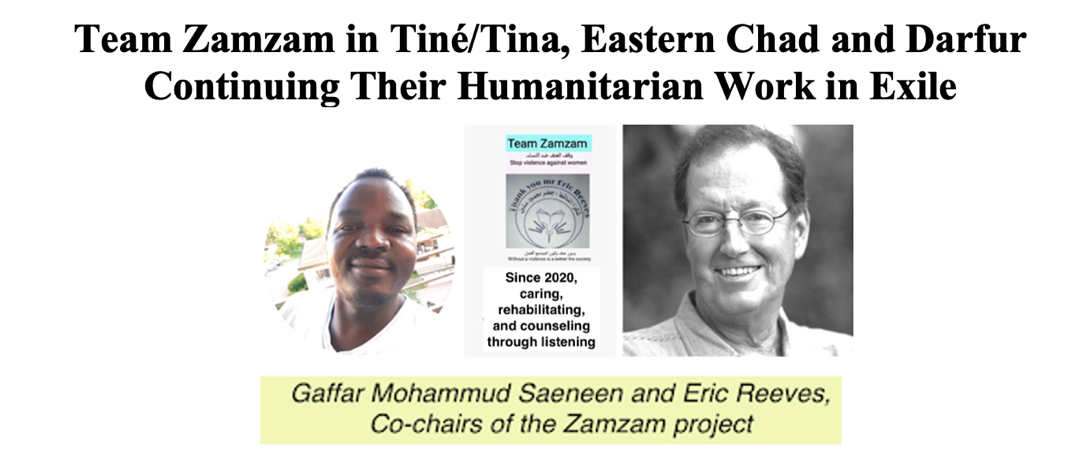
International attention to the unfolding catastrophe of El Fasher—capital of North Darfur State and lying 15 kilometers to the northeast of what was formerly Zamzam IDP camp—has finally become significant but in tragically belated fashion. We hear a great many words of condemnation and demands made of the Rapid Support Forces (RSF)—none of which has had the slightest effect, certainly not in the desperate lives of those still alive inside El Fasher or fleeing from it. After a ruthless siege of a year and a half, residents and those who flee are terribly weakened and acutely malnourished. The RSF has engaged in mass executions, rape, kidnapping, torture and abuses beyond description—and they remain utterly unconstrained.
There is no civilian protection in this part of North Darfur, and the humanitarian presence in nearby Tawila (60 kilometers to the west) is not nearly adequate to respond to the needs of a flood of desperately needy displaced persons. With the aid of the knowledge from my extraordinarily informed colleague Gaffar, I have warned for many months of the consequences of RSF seizure of El Fasher; these became particularly forceful after the RSF attacked and essentially destroyed Zamzam IDP camp, original home to Project Zamzam. For those who wish to see the particular forms of my recent warnings and assessments, I invite perusal of my Twitter feed @SudanReeves .
The violence is not diminishing and there are clear signs that the RSF will continue its violent predations, perhaps extending to Tawila. An immense convoy of heavy weapons for the RSF—funded by and deployed through the United Arab Emirates (UAE)—is reported near the Chad/Darfur border. In addition to the immense arsenal of sophisticated weaponry the UAE has already supplied—including extraordinarily destructive drones—the major addition is clearly intended by the Emiratis to enable the RSF to consolidate its hold on all of Darfur.
- Implications for Project Zamzam in Exile (Tina/Tiné) on the Chad/Darfur border
Team Zamzam continues and is expanding its work in Tina/Tiné, at least for the present. The project faces two major obstacles: a funding crisis (which may be mitigated somewhat in the near future, but please see here to help!) and a critical security threat from the RSF. Gaffar remains convinced that Tina/Tiné will not be attacked because of the importance of this significant cross-border city to the Chadian regime. There is also a large Chadian military garrison nearby and Chad certainly does not want to countenance any military action that threatens its own sovereignty.
But Chadian “President” Déby is in a weak and perilous situation domestically and is heavily reliant on money from the UAE. This is the primary reason he has allowed the Amdjarass region in the remote northeast section of his country to be used by the UAE as a transport point for military equipment, a fact well-established by many investigations and authoritative reports, including by the UN. The UAE may well demand of Déby that he acquiesce in the RSF’s continuing genocidal assault on the non-Arab tribal groups of Darfur, particularly the Zaghawa, who made up such a large part of the population of El Fasher and Zamzam.
At this point it is unclear whether the international community is prepared to halt the genocide (it appears unlikely) or at least to insist on the provision and protection of humanitarian relief aid. Indeed, there seems to be no willingness on the part of the UN, the US, the EU, the UK, Canada, and many others to call out the UAE for its complicity in genocide. El Fasher remains the epicenter of ongoing famine in Sudan. Kadugli in South Kordofan is the site of another siege, which has created a huge risk of mass starvation. The Integrated Food Security Phase Classification, the leading international authority on hunger crises, and Associated Press reports (November 3, 2025) that “El Fasher and Kadugli have experienced ‘a total collapse of livelihoods, starvation, extremely high levels of malnutrition and death.” The headline to the AP report is impossibly grim: “Nearly 400,000 people are starving in Sudan, a new report finds.”
- The Response of Team Zamzam
A full report on the activities of Team Zamzam will be forthcoming soon. Suffice it for the moment to say that their work continues, grows, and has become a model for the community of local humanitarian groups in the Tina/Tiné area. The number of new arrivals continues to grow rapidly, although many pass on to Chad. Very recent photographs highlight the work of the Team in responding to acute malnutrition. Notably, Médecins Sans Frontières/Doctors Without Borders (MSF) recently reported that of children under five arriving in Tawila, 100% were either acutely or severely malnourished. Children who should reach Tina/Tiné will be in similarly distressed condition.
It should be said here that there is considerable concern within the humanitarian community about the fate of the 260,000 people estimated to be inside El Fasher as recently as August. But only a few thousand have escaped the city and arrived in Tawila.
Associated Press reports (November 2, 2025):
Only a few thousand Sudanese have reached the nearest camp for displaced people in the days since Sudan’s paramilitary forces seized El Fasher city, raising fears over tens of thousands who might still be trapped as survivors described killings and other atrocities, an aid group said Sunday.
The Rapid Support Forces took control of the western Darfur region last week, after ousting the rival Sudanese army from the city that was besieged for 18 months. Since then, reports and videos have circulated of RSF atrocities against civilians including beatings, killings and sexual assaults, according to testimonies by civilians and aid workers. The dead included at least 460 killed in the hospital, according to the World Health Organization.
The U.N. migration agency said Sunday it estimates that more than 8,000 people were displaced from el-Fasher on Saturday and Sunday. A total of 70,894 people have been displaced since the RSF took control, it said.
However, less than 6,000 have made it to the nearest camp in Tawila, 65 kilometers (40 miles) away, said Shashwat Saraf, Sudan director for the Norwegian Refugee Council, which runs the camp.
The disparity in numbers prompted MSF to ask:
“The arrival numbers don’t add up, while accounts of large-scale atrocities are mounting,” said Michel Olivier Lacharité, MSF head of emergencies. “Where are all the missing people?”
We still don’t know the answer and at this point such ignorance portends massive human destruction, reports of which from within El Fasher are horrific. The New Arab (November 3, 2025) gives us what is perhaps the most detailed account of what life in El Fasher is like under the RSF. We and Team Zamzam await the ultimate fate of the people of El Fasher, ready to assist in all possible ways those who might reach Tina/Tiné. But the number who will survive inside El Fasher, and in efforts to escape, diminishes dramatically by the day.
• The scale of human destruction—and international impotence—makes the invocation of Rwanda daily more inevitable:
Sudan: El Fasher civilians starved as notorious RSF destroys food kitchens
The New Arab (November 3, 2025)
The Sudanese city of El Fasher, capital of North Darfur, is suffering a deliberate campaign of starvation and destruction, residents and aid workers say, after the notorious paramilitary, the Rapid Support Forces (RSF), destroyed charitable food kitchens, looted hospitals, and cut off routes out of the besieged city.
Survivors who spoke to The New Arab’s Arabic edition Al-Araby Al-Jadeed described El Fasher as a “city of ghosts”, where civilians are trapped without food, medicine, or safe passage while RSF fighters go on a rampage.
“We faced torture, hunger, and killing,” said one displaced man who fled to the nearby town of Tawila. “Even the donkey carts used by the elderly and children were destroyed to stop people from escaping.”
According to residents, the RSF’s campaign has targeted the tekayas—charitable kitchens that once provided daily meals to the poor—along with markets and water infrastructure. “The tekayas were the only refuge people had,” said Mohammad Othman, who ran one of them.
[A version of these tekayas has become a specialty of Team Zamzam in Tina/Tiné—ER]
“After the militias entered, they destroyed everything that kept them running and killed many of the workers. They wanted people to die of hunger.”
Sit al-Nafr Mahmoud, who fled the city last week with her children, said: “El Fasher has become a ghost city. Movement is dangerous and mostly banned. All essential services have collapsed—water, food kitchens, and markets are gone. Life has become unbearable, especially for children and the elderly. Even our homes were looted.”
Witnesses said the RSF has also used extortion to control who can leave.
“They are forcing people to pay millions of Sudanese pounds to be allowed out,” one displaced resident said. “Those who can’t pay are trapped.”
Women fleeing the city described being searched by RSF fighters. “We never imagined they would strip-search women for money and gold,” said Aisha Ismail. “Some were forced to leave one woman behind so the others could escape.”
Others spoke of young men being ransomed. “They set prices for people,” said one witness. “For example, 500,000 pounds for a man in exchange for letting his wife and children go.” Many reported that those who could not pay were detained or disappeared, amid reports of a wave of torture and killings, including of women and children, after RSF troops captured the city last week.
A local health official who managed to escape said all hospitals and clinics in El-Fasher had been destroyed or looted. “Medicines were stolen, pharmacies burned, and patients killed on the pretext that they were army soldiers,” he said. “The city is collapsing—people are dying of hunger and disease, and those still inside are only thinking of how to escape.”
Humanitarian access remains almost impossible, while workers say they face arbitrary arrest, harassment, and threats. Around 15 tonnes of medical supplies are reportedly awaiting clearance but remain blocked by security and administrative restrictions.
“People are eating leaves,” said a journalist now displaced in Tawila. “There are no medicines, no food, and no intravenous fluids.”