 Ishraqah Abdel Rahman (58 years old) sits on the dirt ground in the “Bami Jara” camp, in eastern Chad, holding a worn-out pen and trying to draw the letters of her name on a small notebook, while particles of dust rise around her with every letter she writes.
Around Ishraqah, dozens of elderly women were loudly repeating after a young teacher standing in front of a dilapidated wooden blackboard, in a scene that reflects a determination to learn despite the harsh conditions.
These scenes reveal how the “Zamzam” volunteer team has become a beacon of hope in the camp, after opening the first specialized center for literacy and adult education on September 19, 2026, giving displaced women the opportunity to learn the alphabet for the first time in their lives.
The teachers confirm that the classes cannot accommodate more than 60 women, while the number of those wishing to enroll increases daily, creating long waiting lists.
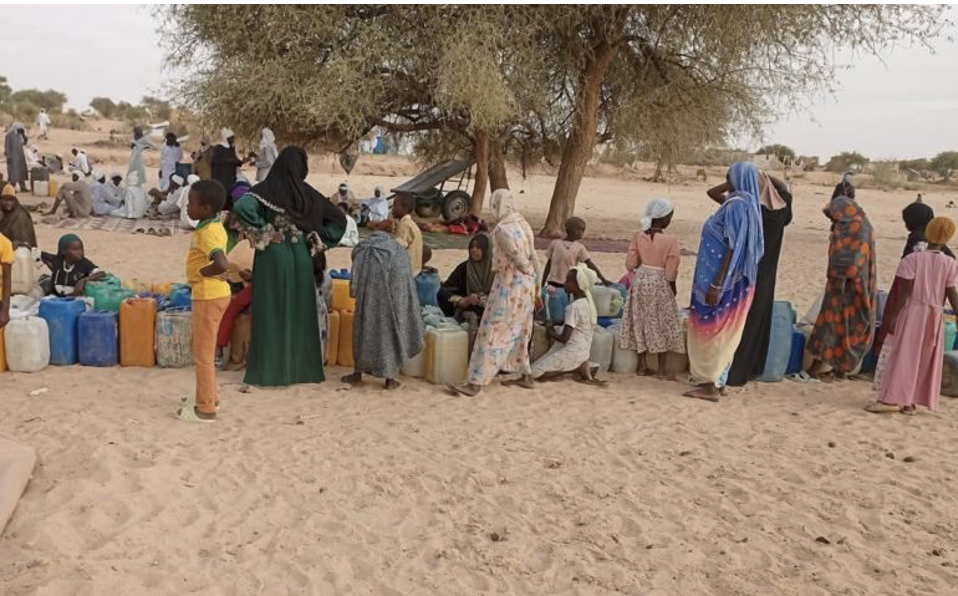 Obtaining water in the “Bami Jara” camp is a daily, arduous task that precedes or follows literacy classes (Al Jazeera)
The pain of illiteracy
Ishraq, who was displaced from El Fasher after losing her home, told Al Jazeera Net: “I used to be ashamed to attend social events because I didn’t know how to read and write, and my children would write down my needs for me. But today, I know the letters and I am trying to write.”
“For the first time in my life, I feel like a human being,” she adds, wiping away a tear. She explains that she used to think learning was only for children and that she was past her prime, but now she makes a point of attending every day despite her family responsibilities. She notes that the journey to the center is long and that she sometimes has to walk in the scorching sun, but she insists on coming because she doesn’t want to remain illiterate until the end of her life.
Zamzam Center
The center established the “Zamzam” team initiative, a group of volunteers, to be the first of its kind in targeting adults, operating with two classrooms serving about 400 children daily in the morning, in addition to about 60 women participating in literacy activities in the evening.
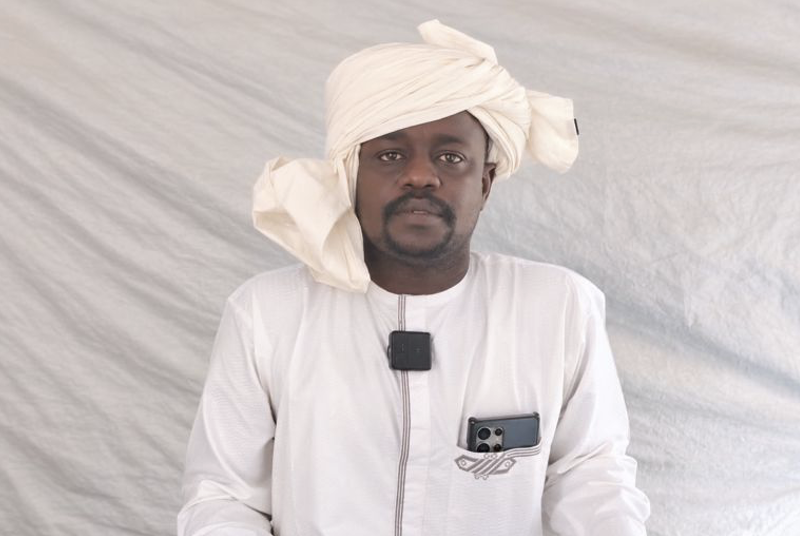 Supervisor of the Zamzam Initiative, Omar Manaqo Muhammad Sharif (Al Jazeera)
The initiative’s supervisor, Omar Manaqo Muhammad Sharif, told Al Jazeera Net: “We noticed that the schools here target only children, while older women don’t even know how to write their names, so we decided to open a classroom for them in the open air.”
He explains that the demand far exceeds the center’s capacity. While the classes can only accommodate 60 women, the number of people wishing to learn exceeds a thousand, forcing the team to create waiting lists and reject large numbers of applicants.
Comprehensive curricula
The curriculum is not limited to teaching Arabic letters only, but also includes lessons in the basics of the Islamic religion, how to perform prayer, the obligations of ablution and washing the dead, in addition to the basics of simple mathematics.
The teachers indicate that lessons on washing the dead have become an urgent necessity in the camp, as a number of women have died without anyone knowing how to wash them, prompting women to learn this ritual to preserve the dignity of the dead.
Sumaya Mohammed Hussein, one of the volunteer teachers, explains that teaching women these basics gives them greater independence in managing their families’ affairs, especially in the absence of men. She notes that some classes are held outdoors under the sun, and that the women endure the heat and time constraints, but refuse to give up on their dream of learning.
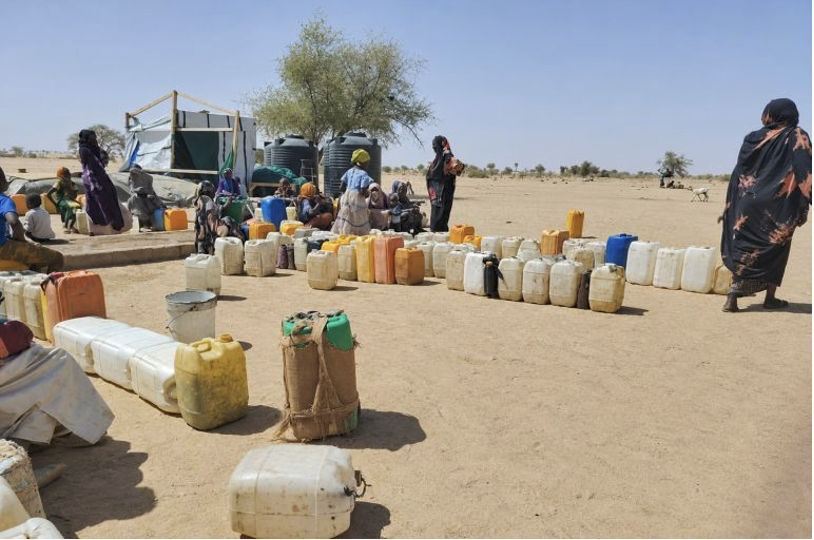 Women and children wait their turn to get water under the scorching sun (Al Jazeera)
Strong will
In the back rows sits Manal Mustafa (62 years old), who comes from the Zamzam camp in North Darfur, and confirms that learning at this age is not easy, especially with poor eyesight and sitting for hours in the sun.
Manal told Al Jazeera Net, “I always wished I could read the Holy Quran without anyone’s help, and now I feel I’m getting closer to that dream step by step.” She added that she shares what she learns with her granddaughter at home, becoming the teacher after having been the student.
Next to her sits Amina Issa (55 years old), who says she learned to write her name for the first time, and that she wants to learn arithmetic so that she can manage household expenses and buy her children’s needs without being deceived by merchants in the market.
Lack of tools
Zahraa Mohammed Al-Hassan, an activist at the camp, confirms that the center faces significant challenges, most notably a shortage of supplies such as pens, notebooks, and chairs, in addition to having to sit in the open air under the sun. She explains that some women arrive at the center after a long day of searching for food and water, but they refuse to stop.
Zahra points out that women make up the vast majority of the population of the “Bami Jara” camp, where the percentage of men does not exceed 9%, which makes women primarily responsible for caring for the family and searching for ways to survive, adding that the center provided them with a space to breathe away from the pressures of daily life.
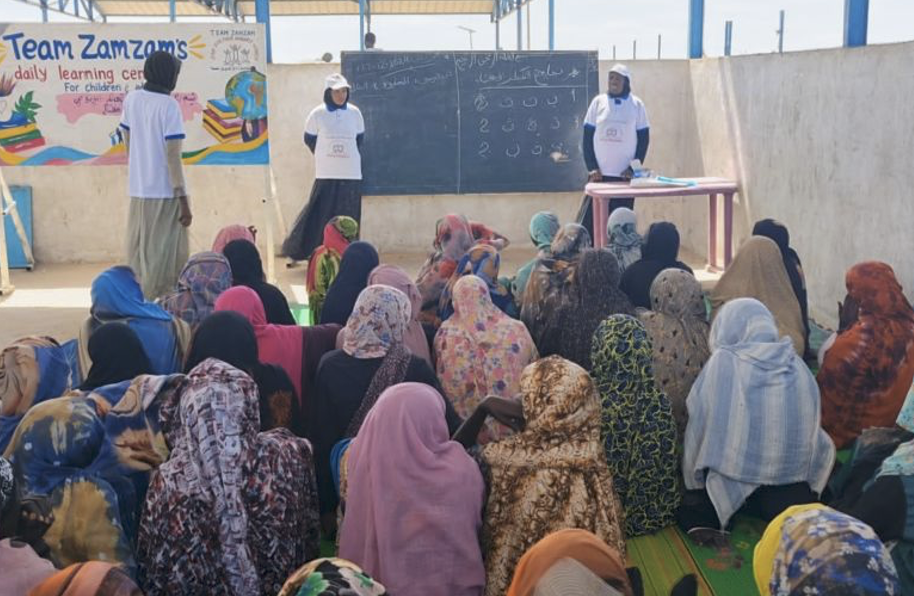 The center suffers from a severe shortage of appropriate equipment and furniture (Al Jazeera)
Shocking figures
Data from the National Institute of Statistics in Chad indicates that the illiteracy rate among female refugees is 79.3%, compared to 68.2% among men, making literacy initiatives a necessity, not a luxury. Approximately 6,000 Sudanese refugees, mostly from Darfur, live in the Bami Jara camp, with women and children comprising the vast majority of the population.
As Ishraqah sits with her small notebook in a corner of the center, writing her name for the first time in a wavy script, the voices of the women rise in unison, repeating after the teacher. With the number of women eager to learn exceeding the capacity of the classrooms and women standing in long queues, the question remains: how many more women in the Chadian camps are waiting their turn to learn to read, and how many voices will remain silent because they have not found anyone to teach them a single letter?