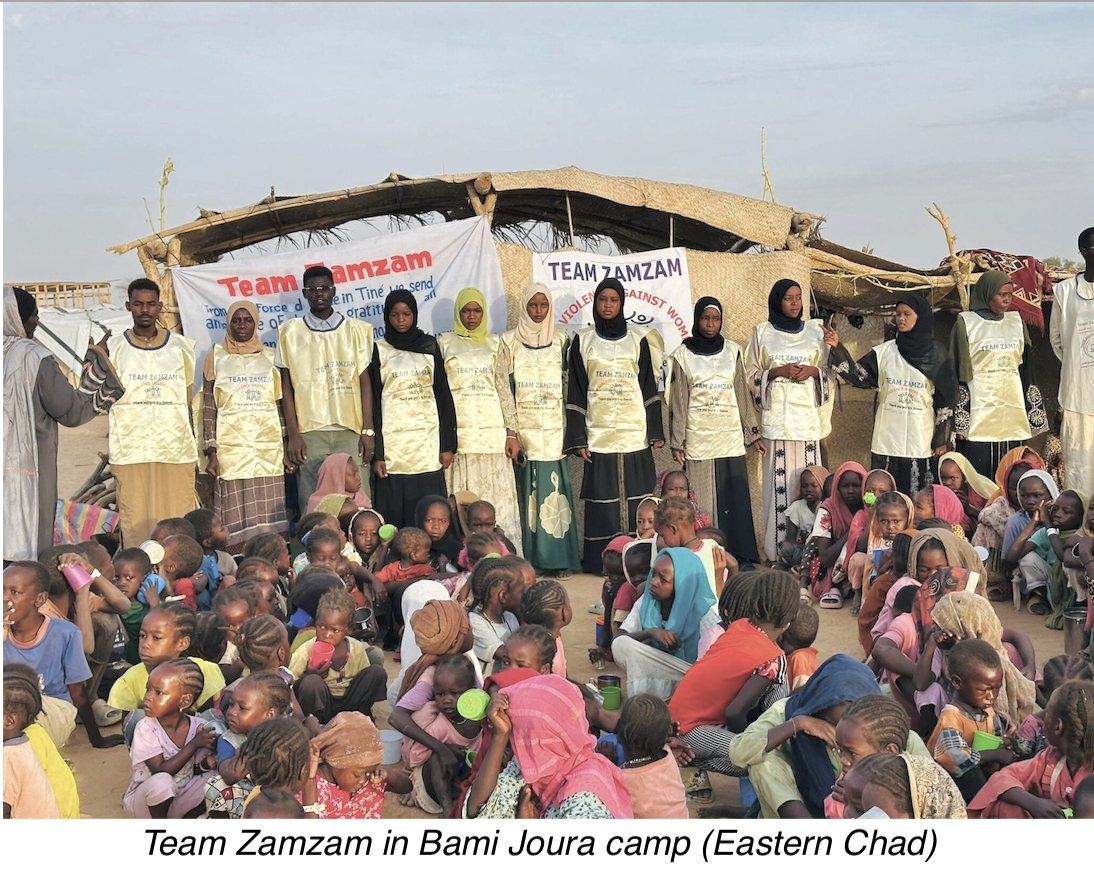
TEAM ZAMZAM MONTHLY HUMANITARIAN REPORT
Reporting Period: Mid-August – Mid-September 2026
From the counselors of Team Zamzam
(translated by Gaffar Mohammud Saeneen)
Executive Summary
The people of Darfur have endured years of armed conflict, displacement, death, destruction, and profound humanitarian suffering. For many Sudanese who have fled across the border in search of safety, displacement has not brought an end to these hardships. Instead, refugees continue to face a combination of humanitarian challenges, including inadequate shelter, food insecurity, poverty, limited access to healthcare, insecurity, overcrowding, and exposure to natural disasters.
This report highlights the humanitarian situation of Sudanese refugees in eastern Chad, with particular attention to Bami-Jura refugee camp in the Chadian locality of Tina, as well as the increasingly critical humanitarian situation affecting communities in North Darfur. During the reporting period, Bami-Jura was severely affected by a violent weather event involving heavy rainfall, dust, and strong winds. The disaster caused extensive damage to shelters and personal belongings and resulted in deaths and injuries, particularly among children and women.
Information collected by Team Zamzam and affected residents indicates that several people lost their lives, including young children and an elderly person, while more than 27 people sustained injuries. Other survivor accounts reported additional casualties and injuries. These figures require further verification; however, there is no doubt that the incident resulted in significant loss of life, injury, displacement, and destruction.
The disaster exposed the extreme vulnerability of refugees living in temporary shelters that were not designed to withstand severe weather conditions, prolonged displacement, or the increasing population density within the camp.
At the same time, reports received from communities in North Darfur indicate an emerging risk of drought, food insecurity, water shortages, livestock losses, and further displacement. These risks are compounded by ongoing armed conflict and insecurity.
Team Zamzam therefore calls for urgent humanitarian action to protect vulnerable civilians, strengthen assistance in Bami-Jura, facilitate the safe relocation of refugees where appropriate, and establish early-warning and preventive interventions in North Darfur.
Humanitarian Situation in Bami-Jura
The humanitarian situation in Bami-Jura remains extremely concerning.
Bami-Jura functions as an important reception and transit point for newly arriving Sudanese refugees fleeing conflict and insecurity from different parts of Sudan. Refugees initially arrive at the site for registration and other reception procedures before being transferred to more established refugee camps, including Mayba, Kari Yari, Ardimi, Talum, Malha, Hirba, Colombo, and other camps in eastern Chad.
However, the increasing number of arrivals, combined with the slow pace of relocation, has placed severe pressure on the camp’s already limited infrastructure and humanitarian services.
Shelter and Living Conditions
Shelters in Bami-Jura were established primarily as emergency reception facilities. Many were constructed using locally available and temporary materials and were not intended to accommodate large numbers of people for extended periods.
The rapid increase in the refugee population has resulted in severe overcrowding. Shelters originally intended for a limited number of families are now accommodating substantially larger numbers of people.
The recent storm demonstrated the consequences of inadequate shelter conditions and overcrowding. Numerous shelters collapsed or were severely damaged, leaving families exposed to rain, wind, dust, and other environmental hazards.
Food, clothing, blankets, sleeping mats, cooking equipment, and other essential household items were also damaged or destroyed by the rain, dust, and strong winds. Only a small proportion of these items remained usable.
Many families were consequently left with little more than the ground on which to sleep. Some families temporarily moved to other locations because of fears that another severe weather event could result in further casualties and destruction.
The situation demonstrates the urgent need for emergency shelter assistance, shelter reinforcement, replacement of damaged structures, and improved camp infrastructure.
Economic Hardship
Refugees face severe economic hardship due to the absence of reliable sources of income and the increasing cost of basic goods and services.
Food prices, healthcare costs, transportation expenses, and other essential living costs continue to place enormous pressure on already vulnerable households.
Currency-exchange challenges further reduce the value of financial assistance received from relatives and other sources. Families report that significant portions of money transfers can be lost through transfer fees and exchange-rate differences, leaving recipients with insufficient funds to meet basic needs.
The overall cost of living in and around the refugee camps has therefore become extremely difficult for many families to sustain.
Urgent Appeal: Risk of Drought and Food Insecurity in North Darfur
Team Zamzam is issuing an urgent humanitarian appeal concerning the deteriorating situation in North Darfur. Reports received from communities and displaced people indicate severe shortages of rainfall. in several parts of Sudan during the current agricultural season. In some areas, crops have reportedly failed to develop adequately and pasture has deteriorated because of insufficient rainfall.
These conditions create a serious risk of drought, food insecurity, livestock losses, and a wider humanitarian crisis, particularly in North Darfur, where communities are already severely affected by conflict and insecurity. The situation is further aggravated by repeated attacks and insecurity affecting civilians, farmers, pastoralists, and rural communities.
Through communications with residents and people who have recently arrived in refugee camps in eastern Chad, Team Zamzam has received deeply concerning accounts of the conditions facing communities inside North Darfur.
Some residents reportedly spend days and nights near traditional wells in order to obtain drinking water for themselves and their livestock while remaining exposed to the risk of armed attacks.
Large numbers of camels, cattle, sheep, and other livestock have reportedly died from hunger and thirst. The animals that remain are at continued risk of death, theft, or loss if urgent measures are not taken.
Hundreds of families have reportedly been forced to send children and elderly relatives to refugee and displacement camps in search of safety and survival.
However, some families cannot afford transportation to safer areas. Others have lost their livestock, leaving them without the means to transport children, elderly people, persons with disabilities, or essential belongings. The shortage of cash and disruption of local economic activity have further isolated affected communities.
Urgent Recommendations
Government of Sudan
The Government of Sudan should fulfil its responsibility to protect and assist affected
civilians by:
*Establishing emergency monitoring and coordination mechanisms.
*Maintaining regular communication with affected communities.
*Coordinating with local and international humanitarian organizations.
*Engaging neighbouring countries and regional partners where necessary.
*Facilitating the delivery of food, water, healthcare, shelter, and other essential assistance.
*Supporting safe and sustained humanitarian access to affected communities.
*Strengthening early-warning and preparedness mechanisms for drought and food-security emergencies.
Sudanese Civil Society and the Sudanese Community
Sudanese individuals, civil society organizations, community leaders, media outlets, humanitarian actors, and members of the Sudanese diaspora are urged to raise awareness and support affected communities through:
*Financial and material assistance.
*Humanitarian advocacy.
*Media coverage and public awareness.
*Psychological and moral support.
*Community-based emergency initiatives.
*Support for vulnerable households seeking safe displacement.
Affected communities are currently caught between the threat of armed violence on one side and drought, hunger, thirst, and economic collapse on the other.
International Humanitarian Community
The United Nations, its agencies—including the World Food Programme—and other humanitarian organizations working in food security, protection, health, water and sanitation, shelter, and disaster response are urged to closely monitor the situation in Sudan, particularly North Darfur.
Humanitarian actors should prepare preventive and life-saving interventions before conditions deteriorate further.
International Community
Team Zamzam appeals to governments, humanitarian organizations, donors, civil society groups, and individuals around the world who are committed to humanitarian principles to stand in solidarity with the people of Sudan, particularly vulnerable communities in North Darfur. Urgent action is needed now to prevent a larger humanitarian catastrophe.
Security Situation in Bami-Jura
The security situation in Bami-Jura remains highly concerning. Although the camp is located inside Chadian territory, its proximity to the Sudan–Chad border places it in a particularly sensitive and volatile environment. Refugees remain exposed to several risks, including:
* Potential cross-border armed violence.
* Armed groups operating in surrounding areas.
* Community tensions relating to land and access to resources.
* Restrictions on movement outside the camp.
* Heavy rainfall, flooding, dust storms, and strong winds.
* Further displacement should insecurity or environmental hazards worsen.
* Refugees face significant restrictions on movement outside the camp and report feeling unsafe when travelling even relatively short distances.
*The recent destruction caused by severe weather has further increased fear and insecurity among residents.
Given these conditions, there is an urgent need to strengthen security arrangements, improve humanitarian services, reinforce shelters, and consider the relocation of particularly vulnerable refugees from Bami Jura to more established and secure camps where appropriate and feasible.
Health Situation
The health situation in Bami-Jura is also extremely concerning. The camp continues to receive significant numbers of refugees while the pace of relocation to established camps has slowed considerably.
According to residents, newly arrived refugees were previously transferred approximately every 15–20 days. Transfers are now reportedly taking several months, with some people remaining in the reception area for six to eight months or longer. This prolonged stay has contributed to severe over-crowding. Facilities originally designed to accommodate a limited number of families are now hosting significantly larger populations. Such overcrowding creates serious public-health risks and places additional pressure on already limited healthcare and sanitation services.
Commonly reported illnesses include:
* Fever and other febrile illnesses.
* Respiratory infections and colds.
* Diarrhoeal diseases.
* Malaria.
* Tonsillitis and other infections.
* Other communicable diseases.
Poor sanitation, overcrowding, inadequate shelter, and the presence of flies and other vectors contribute to the spread of disease. Pregnant women are particularly vulnerable and may face childbirth in overcrowded or inadequate conditions because of limited access to appropriate maternal healthcare. The situation requires urgent health, water, sanitation and hygiene (WASH), maternal health, disease prevention, child health, and mental health interventions.
Team Zamzam is one of the teams operating directly inside Bami Jura camp and continues to monitor developments and support vulnerable refugees on an ongoing basis. The team regularly follows the arrival of new refugees and provides assistance intended to reduce immediate household pressure.
Food and Essential Household Assistance
During the reporting period, Team Zamzam distributed basic food and household items as follows:
Sugar – 50 kg bags 8
Milk – 25 kg bags 6
Cooking charcoal – 8 bags
Cooking oil – 4 jerrycans × 27 each
Tomatoes – 14 cartons
Onions – 2 bags × 100 each
Pasta – 10 nets/packages
Biscuits – 40 cartons
Salt – 1 carton
****************************
Buckets – 80
Plastic sheeting/tarpaulins – 67
Sleeping mats – 40
(Quantities are presented as recorded by Team Zamzam and may require clarification of individual packaging or unit measurements for future reporting—Gaffar.)
Emergency Response Following the Storm
[the region is still in the midst of the rainy season, although the rains have been generally very poor—an ominous sign for what looks like a largely failed fall harvest—ER]
Following the recent storm, Team Zamzam also provided assistance to families affected by heavy rainfall, dust, and strong winds. The response focused on helping affected households meet immediate shelter and household needs following the destruction or damage of temporary structures and personal belongings.
Psychosocial and Social Support
In addition to material assistance, Team Zamzam provides:
- Psychological and social support to survivors of sexual violence.
- Basic guidance and counselling.
- Humanitarian awareness and practical advice.
- Emotional support to families experiencing severe hardship, loss, and displacement.
- Follow-up with affected households.
- Monitoring of emerging humanitarian and protection needs.
- Advocacy for additional humanitarian support and urgent intervention from relevant organizations.
Beneficiary Reach and Key Achievements
During the reporting period, Team Zamzam reached vulnerable refugees through food assistance, nutrition support, and psychosocial services.
Food Assistance
A total of 372 households, comprising 1,623 individuals, benefited from the distribution of basic food supplies.
Morning Breakfast Programme
A total of 2,524 children benefited from the morning breakfast programme, supporting their access to nutritious food and contributing to their health and well-being.
Psychosocial Counseling
A total of 44 individuals participated in psychosocial counseling sessions, providing access to essential psychological support and contributing to the mental well-being of survivors of sexual violence and other vulnerable individuals.
Beneficiary Testimonies
Testimony 1 — Father Who Lost His Children
One young father who lost children during the recent weather disaster described the devastating impact of the storm. According to his account, heavy rainfall accompanied by strong winds caused a shelter to collapse and roofing materials to be blown away, resulting in deaths and injuries among residents.
He reported that several people were injured and that children from his own family were among those who died. Another child sustained a serious head injury and was receiving treatment at a hospital. The father explained that his family had already spent more than four months in the camp, living under constant fear and psychological distress. He expressed frustration over what he described as inadequate follow-up of temporary shelters and insufficient humanitarian services, particularly regarding transportation and relocation to established camps. He stated that his family had already lost almost everything as a result of the war and had now suffered another devastating loss in the refugee camp.
Testimony 2 — Female Survivor
A woman who lost children in the disaster described humanitarian services in the camp as extremely slow. She explained that although refugee committees may provide initial reception and registration when people arrive, many families subsequently experience limited follow-up and inadequate access to essential services.
She called for urgent intervention and greater attention to the rights, dignity, safety, and protection needs of refugees.
Survivor Protection Case
CONFIDENTIAL PROTECTION CASE
To protect the survivor’s privacy and dignity, identifying information has been limited and the survivor is referred to only by the initials [F.A.M.].
The Team Zamzam documented the case of a 17-year-old girl originally from Al-Fasher, Al-Nasr neighbourhood. Following the escalation of the conflict, she and her mother attempted to leave the city in search of safety. While travelling towards the Qurna area, approximately 20 kilometres northeast of Al-Fasher, they reported encountering armed individuals associated with the Rapid Support Forces (RSF), who were reportedly involved in robbery and attacks against civilians fleeing the area.
The girl became separated from her mother and was subsequently subjected to sexual violence and physical assault. She was also stabbed in her right hand and left in a severely distressed condition. She was later assisted by acquaintances and eventually reached Qurna before continuing her journey towards refugee camps in eastern Chad.
She is currently in Bami-Jura camp and is experiencing severe psychological distress. Team Zamzam has provided psychosocial and social support while continuing to monitor her situation and protection needs. This case highlights the severe protection risks faced by women and girls fleeing conflict and underscores the urgent need for survivor-centred protection services, psychosocial support, healthcare, safe referral mechanisms, and confidential case management. All information concerning this case should be treated as strictly confidential.
Obstetric Fistula Case
CONFIDENTIAL PROTECTION AND HEALTH CASE
Team Zamzam has also observed serious reproductive-health challenges among displaced and refugee women and girls, particularly among young first-time mothers. One case concerns a young woman identified as [A.M.S.], who was approximately 20 years old at the time of her first pregnancy. She reportedly went into labour outside a healthcare facility while travelling between Al-Fasher and Tawila.
The baby died shortly after birth, and the mother subsequently developed an obstetric fistula, a serious childbirth-related medical condition requiring specialized treatment. The woman’s husband had also reportedly been killed during the conflict in Al-Fasher before the family was displaced.
Her experience demonstrates the devastating intersection of armed conflict, displacement, limited access to skilled maternal healthcare, and inadequate access to specialized medical services. Urgent access to specialized fistula treatment, maternal healthcare, psychosocial support, and long-term rehabilitation is required for women living with obstetric fistula. All information concerning this case should be treated as strictly confidential and shared only through appropriate protection and medical referral channels.
Key Humanitarian Priorities
Based on information collected during this reporting period, Team Zamzam identifies the following urgent priorities:
* Emergency shelter assistance for families whose shelters have been destroyed or damaged.
* Food assistance for newly arrived and highly vulnerable households.
* Clean water and sanitation services to reduce the risk of disease.
* Emergency healthcare, including maternal, newborn, and child health services.
* Protection services for women, children, survivors of violence, persons with disabilities, and other vulnerable groups.
* Psychosocial support for refugees affected by conflict, displacement, bereavement, and trauma.
* Safe and appropriate relocation from Bami-Jura to established refugee camps where feasible and in accordance with protection considerations.
*Improved camp management and shelter maintenance, including regular structural assessments and replacement of unsafe temporary structures.
*Emergency assistance to communities in North Darfur facing drought, food insecurity, water shortages, livestock losses, and insecurity.
*Improved humanitarian coordination among Sudanese and Chadian authorities, UN agencies, international and national NGOs, community organizations, and local humanitarian initiatives.
*Early-warning and preparedness mechanisms for natural disasters, drought, food insecurity, and other humanitarian emergencies.
*Specialized medical referral services, particularly for survivors of sexual violence and women living with obstetric fistula.
*Improved transportation and referral mechanisms for vulnerable refugees, including children, elderly people, persons with disabilities, pregnant women, and survivors of violence.
Conclusion
The humanitarian situation facing Sudanese refugees in eastern Chad and vulnerable communities remaining in North Darfur continues to deteriorate. For people who fled war in search of safety, displacement has not ended their suffering. Refugees continue to face insecurity, inadequate shelter, food shortages, disease, poverty, psychological trauma, overcrowding, and exposure to natural disasters.
The recent disaster in Bami-Jura demonstrates how vulnerable temporary refugee settlements can become when population growth is not matched by adequate shelter, infrastructure, humanitarian services, and protection. At the same time, reports of insufficient rainfall in North Darfur raise serious concerns about an emerging drought and food-security crisis. Communities already weakened by conflict are increasingly struggling to access water, food, pasture, healthcare, transportation, and safe routes to displacement and refugee camps.
The protection cases documented during the reporting period further demonstrate the profound consequences of the conflict for women, children, and other vulnerable people. Survivors require not only immediate assistance but also sustained access to healthcare, psychosocial support, protection services, and safe referral pathways.
Team Zamzam therefore calls upon the Government of Sudan, the Government of Chad, United Nations agencies, international and national humanitarian organizations, donors, civil society organizations, the Sudanese diaspora, media organizations, and concerned individuals worldwide to act urgently.
The people affected by this crisis cannot wait for conditions to deteriorate further. Immediate action is needed to save lives, protect dignity, prevent further suffering, and avert a larger humanitarian catastrophe.