More than three years after Sudan’s catastrophic internal war began in April 2023, the suffering of civilians—especially in Darfur—continues to deepen in ways that are both horrifyingly familiar and newly ominous. There has been no meaningful international effort to halt the destruction of civilian life, no serious attempt to impose accountability on those most responsible, and no humanitarian response remotely commensurate with the scale of human need. This is not because the facts are unclear. On the contrary, the evidence of mass displacement, famine, systematic sexual violence, the collapse of public health infrastructure, and relentless attacks on civilian populations has accumulated for years. What is lacking is political will.
Nor should we permit diplomatic evasions to obscure responsibility. The RSF remains the principal engine of destruction in Darfur, just as it has been since the war began. Its campaign of violence—marked by civilian targeting, ethnic destruction, mass displacement, sexual violence, and the systematic devastation of communities—could not continue at its present scale without sustained external support. Above all, this means the United Arab Emirates, whose provision of arms, logistical assistance, and other war materiel to the RSF is by now widely understood, even if still treated with extraordinary caution by international actors with the power to impose consequences. The silence surrounding Emirati complicity remains one of the most revealing moral failures of this war.
We should also mark another grim anniversary: one year since the RSF’s destruction of Zamzam camp for internally displaced persons in North Darfur. For all its desperate privations, Zamzam had become home to hundreds of thousands of displaced civilians, overwhelmingly women, children, and the elderly—people already driven repeatedly from their homes by years of violence. Its destruction in April 2025 forced another immense human flight, one whose full mortality can only be guessed at. Tens of thousands will already have died from hunger, disease, untreated injuries, exposure, or direct violence. Many more remain in peril.
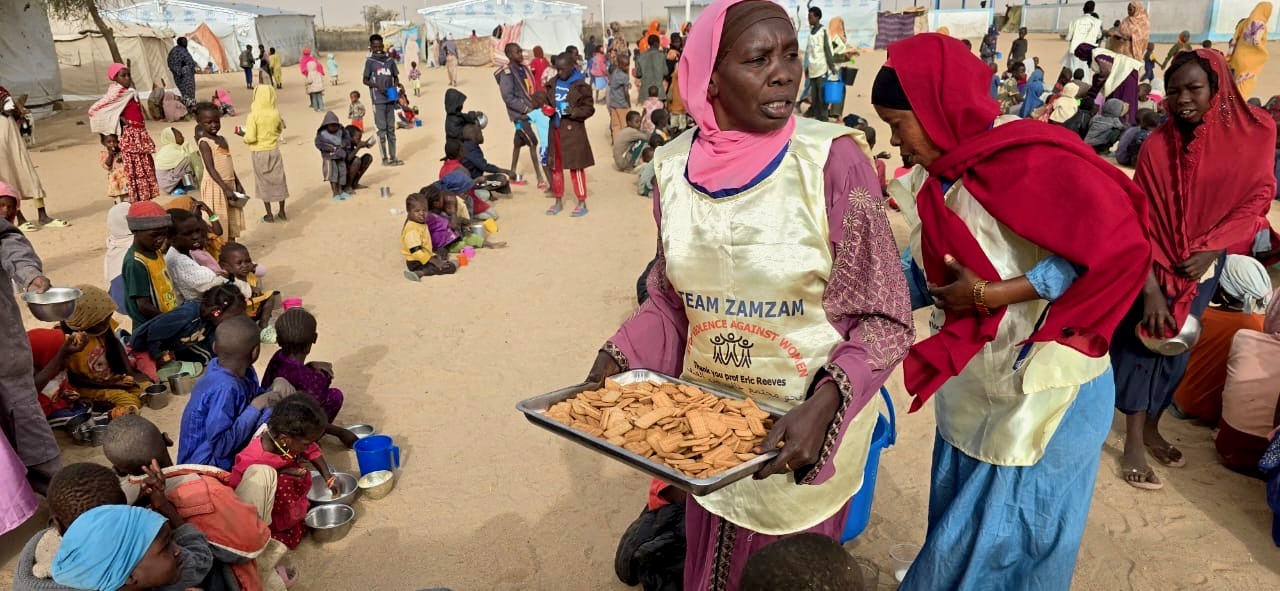
Among those forced to flee were the women who constitute the heart of Project Zamzam. That they were able to reconstitute themselves as a functioning humanitarian team in the Tina/Tiné border region remains extraordinary, though the word should not be romanticized: this was adaptation born of necessity, not triumph. Tina (on the Sudan side) and Tiné (on the Chadian side) form, in effect, a single fractured humanitarian space divided by a broad wadi and an international border that offers only uncertain protection. It is here that a significant number of displaced Darfuris have regrouped, joining a highly mobile and deeply vulnerable population living under increasingly dangerous conditions.
The Team’s latest assessment estimates that more than 35,000 displaced Sudanese are now sheltering in the Tina/Tiné area, overwhelmingly on the Chadian side. Most possess little or nothing by way of stable shelter. Many are living in makeshift structures or in the open, exposed not only to hunger and disease but to the brutal uncertainties that accompany repeated displacement. Population movement remains constant; some move onward to refugee camps deeper inside Chad, others arrive newly displaced from Darfur. This means that humanitarian needs do not remain static, least of all shelter needs. Tent materials already provided by Project Zamzam have proved enormously valuable, with volunteers assisting in assembly and construction. But this is not a one-time requirement that can simply be “met.” Shelter capacity must remain flexible and continuously expandable, especially as new arrivals continue to appear.
And now comes the rainy season.
For anyone familiar with Darfur and eastern Chad, this phrase carries ominous practical meaning. Roads become impassable; flooded wadis isolate already vulnerable populations; humanitarian supply routes—fragile even in dry weather—are disrupted or severed altogether. But the greater danger lies in what such conditions do to already weakened human beings. Inadequate shelter becomes an accelerant of disease. Contaminated water sources become deadlier. Cholera becomes an immediate threat; rapid hydration can mean the difference between life and death, but access to clean water and basic medical supplies remains grossly inadequate. Malaria, acute diarrheal disease, respiratory infections, measles, and other communicable illnesses spread rapidly in overcrowded conditions. Hunger and disease begin reinforcing one another in familiar and lethal ways.
Recent IPC alerts have only underscored the gravity of what lies ahead. Acute malnutrition in additional North Darfur localities has surpassed famine thresholds, and humanitarian analysts have made clear that conditions in surrounding areas may be equally catastrophic, though insecurity and lack of access prevent comprehensive assessment. Food prices continue to rise sharply; availability declines; Sudan’s coming agricultural season is itself imperiled by war, fuel shortages, insecurity, and collapsing infrastructure. Humanitarian agencies understand what is unfolding. Some are attempting to pre-position supplies before roads close. But once again, need vastly exceeds response capacity, while political obstruction, insecurity, and chronic funding failures continue to cripple larger humanitarian efforts.
It is precisely in such circumstances that a small, locally embedded initiative like Project Zamzam can matter disproportionately. No one should mistake this for a claim that our resources match the scale of catastrophe; they do not. But what the Team possesses is operational agility, trusted relationships within displaced communities, and the ability to respond directly and quickly where larger organizations often cannot. The women of Project Zamzam continue their original psychosocial work with survivors of sexual violence while increasingly confronting the far broader humanitarian emergency now defining life in the Tina/Tiné corridor: food insecurity, shelter crises, disease risk, and the daily struggle for survival.
Their report appears here.
I again take the opportunity to I would remind our supporters that it is now possible to make a tax-deductible contribution to our project, using a portal on the website of a 501/c/3 organization operating in Sudan. Operation Broken Silence, our fiscal partner, works primarily on health and education issues in the Nuba Mountains of South Kordofan; OBS has created a special site for tax-deductible contributions to our project, and we hope this makes contributing to the health and well-being of the people served by Team Zamzam easier for donors.