Overview (Eric) The world has marked the third anniversary of Sudan’s catastrophic internal war, but without finding the moral or political resources to end it. The failure to call out the United Arab Emirates, sponsor of genocidal Rapid Support Forces (RSF), is all too telling.
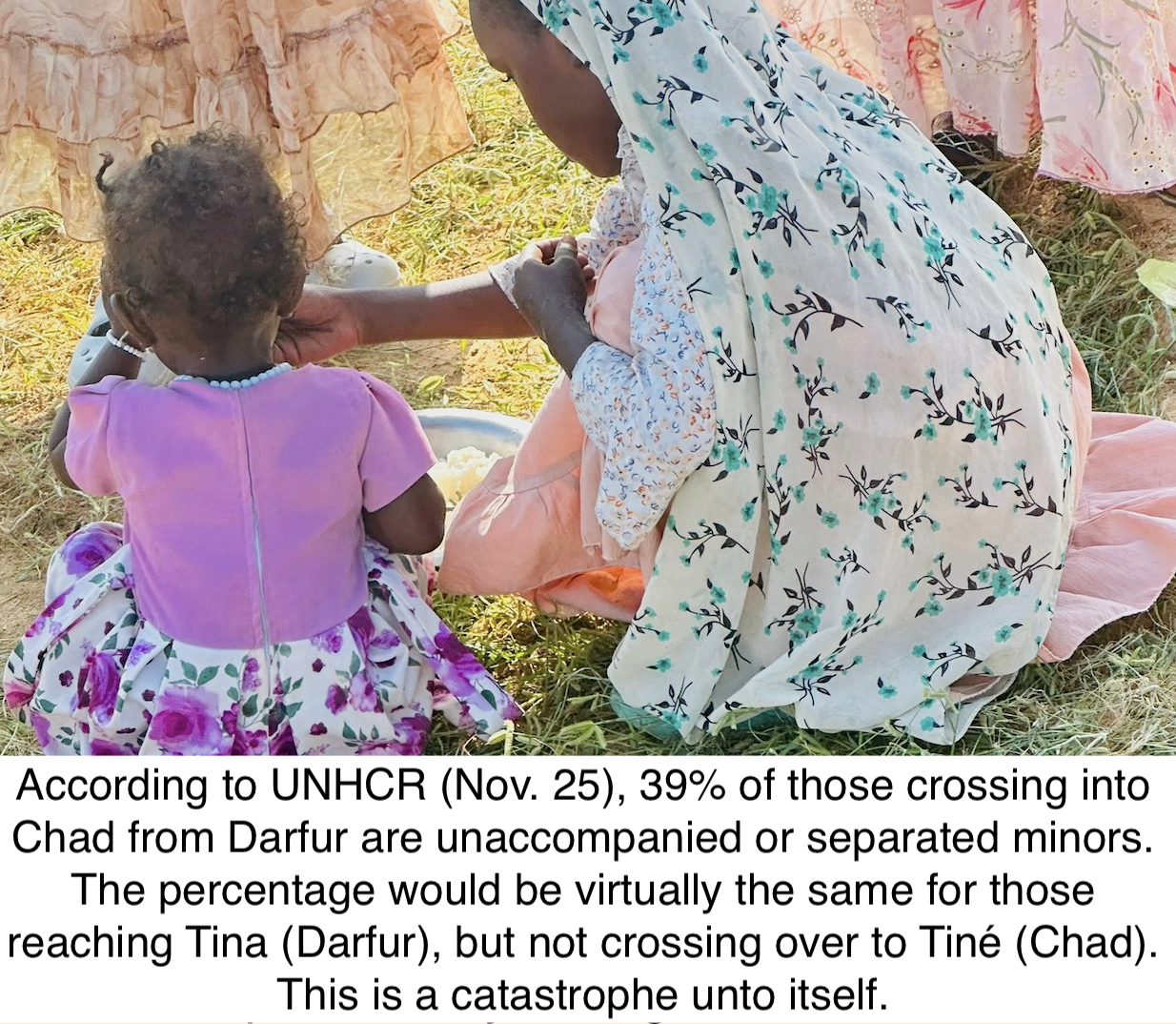
We should also mark the anniversary of the RSF’s overrunning of Zamzam camp for internally displaced persons (mid-April 2025), forcing more than half a million people—overwhelmingly women, children, and the elderly—without the means of sustaining themselves. Tens of thousands will have died by this time for lack of food, water, medicine, shelter—or protection from marauding RSF militiamen. Team Zamzam was among the many hundreds of thousands forced to flee…and yet by a small miracle they were able to reconstitute themselves as a team in Tina (Darfur) and Tiné (Chad), actually one city straddling an international border marked by a large wadi (dry riverbed). The Team has been forced to adjust to rapidly changing conditions (including security conditions), and a multitude of challenges (Zamzam camp had been the only home they had known—for some, more than 20 years).
Truly remarkably, they have found a way (like then mythical Zamzam well in Mecca) to renew not only themselves but their lifegiving and lifesaving humanitarian assistance to the very large displaced populations on both sides of the border, many coming from Zamzam camp and El Fasher—some still arriving after making their difficult way west in North Darfur.
Their work for 2025 is summarized in: Team Zamzam, 2025: An Annual Digest of Work and Finances | January 10, 2026 [ https://wp.me/p45rOG-2VK ]. Monthly updates for more than five years of work are also archived at www.sudanreeves.org .
This month’s report from the Team’s coordinating counselor (translated by Gaffar) appears below. It provides a view from the ground that is extremely difficult to gather from other sources. As preface to this important report, I offer a brief highlighting of the most important news about the broader situation on the ground in Sudan as well as issues specific to the “Tina/Tine” area.
PHYSICAL SECURITY
• Fighting continues in many locations in the Kordofans of Sudan as well as a new front in Blue Nile, where the RSF has used a base in western Ethiopia—financed by the UAE—to mount attacks. This has resulted in the seizure of the important town of Kurmuk—and created a new stream of displaced persons:

This has been a strategy of the Janjaweed beginning in 2003, and continuing with the creation of the RSF by then-President Omar al-Bashir in 2013. Present famine and near famine conditions continue in large areas of Sudan and are a direct result of these genocidal actions:
• Drone warfare has increased dramatically over the course of the war; both the RSF and the Sudan Armed Forces (SAF) have targeted areas with large civilian populations, including medical facilities. The RSF has proved distinctly the most criminal in its use of drones, all coming from the UAE—and increasingly sophisticated.
• For what remains perhaps our best recent news reporting on UAE support for the RSF, see The Wall Street Journal, October 28, 2025: “How U.A.E. Arms Bolstered a Sudanese Militia Accused of Genocide.” One paragraph is key:
U.S. intelligence agencies say the United Arab Emirates sent increasing supplies of weapons including sophisticated Chinese drones to a major Sudanese militia this year, bolstering a group that has been accused of genocide and pouring fuel on a conflict that has created one of the world’s worst humanitarian crises. Separate reports, including from the Defense Intelligence Agency and the State Department’s intelligence bureau, show an increase in the flow of materiel from the U.A.E. to the rebel Rapid Support Forces since the spring, according to U.S. officials familiar with the intelligence.
The U.S. has no monopoly on such intelligence: it is well known among EU countries; for example, but none can bring themselves to call out the UAE. Indeed, mention of the UAE at all is strikingly absent from various public statements on the third anniversary of Sudan’s war:
• Statement from the “think tank” of the EU Parliament (April 2026): “Sudan’s humanitarian crisis: Needs and responses” [no mention of UAE’s role in sustaining the war]
• UN News, April 14, 2026: “World failing Sudan as war enters a fourth year, UN relief chief warns” [no mention of UAE’s role in sustaining the war]
• United States State Department, April 18, 2026, “Marking Three Years of Conflict in Sudan with Sanctions and Appeal for Humanitarian Truce.” [no mention of UAE’s role in sustaining the war] What makes this failure to call out the UAE were the words of U.S. Secretary of State Marco Rubio in November 2025:
“I think something needs to be done to cut off the weapons and the support that the RSF is getting as they continue with their advances.”
A month later Rubio still could not bring himself to call out the UAE:
“The top US diplomat [Rubio] pointed to external weapons supplies as a critical factor sustaining the war between the government-aligned Sudanese Armed Forces (SAF) and the paramilitary Rapid Support Forces (RSF), which is now deep into its third brutal year. “All these weapons are acquired from abroad. They have to come from somewhere else and they have to come through somewhere else.”
HUMANITARIAN SITUATION: KEY POINTS AND ASSESSMENTS
- Regional Impact:
“Around 14 million people have been forced from their homes since the war began, many multiple times. Over 4.5 million Sudanese have fled across borders into Chad, Egypt, South Sudan, Libya, Uganda, Ethiopia and the Central African Republic. Inside Sudan, 29 million people face acute food insecurity, with famine conditions already taking hold in some areas.” (International Rescue Committee, April 14, 2026)
• FEWSNet, January 15, 2026:
“Catastrophe (IPC Phase 5) is expected among populations displaced by conflict across North and South Darfur, and among populations in Sheikan in North Kordofan (where El-Obeid town is located) through May. Levels of starvation and acute malnutrition are high, particularly in overcrowded displacement sites. [El Fasher is explicitly designated for famine] (October 2025—May 2026)
“The 2026 Humanitarian Needs and Response Plan is based on a comprehensive, countrywide inter-sectoral analysis of needs in Sudan. In 2026, 33.7 million people require humanitarian assistance — the highest number globally and an increase of 3.3 million from 2025. Those most at risk include women and girls, children, older people, persons with disabilities, internally displaced people, refugees and ethnic minorities, who face heightened protection risks, including violence, exposure to hostilities, explosive hazards, repeated displacement, exploitation and exclusion.”
“After three years of war, Sudan now accounts for the world’s largest humanitarian crisis, with 34 million people needing aid, 21 million lacking health services, and repeated attacks crippling a medical system already weakened by disease and hunger.”
- Funding Shortfalls (UN estimate):
“As of April 2026, Sudan faces the world’s largest humanitarian crisis with roughly $3 billion required for the 2026 response, yet funding remains severely limited. While over €1.15 billion ($1.2B+) was pledged in Berlin, this is insufficient for the 34 million people in need. Over 170 organizations face critical shortages, leaving the response to the three-year conflict critically underfunded.”
********
Monthly Report of Team Zamzam, Reporting Period: Mid-March to Mid-April 2026
(translated by Gaffar Mohammud Saeneen)
[1] Humanitarian Situation Overview
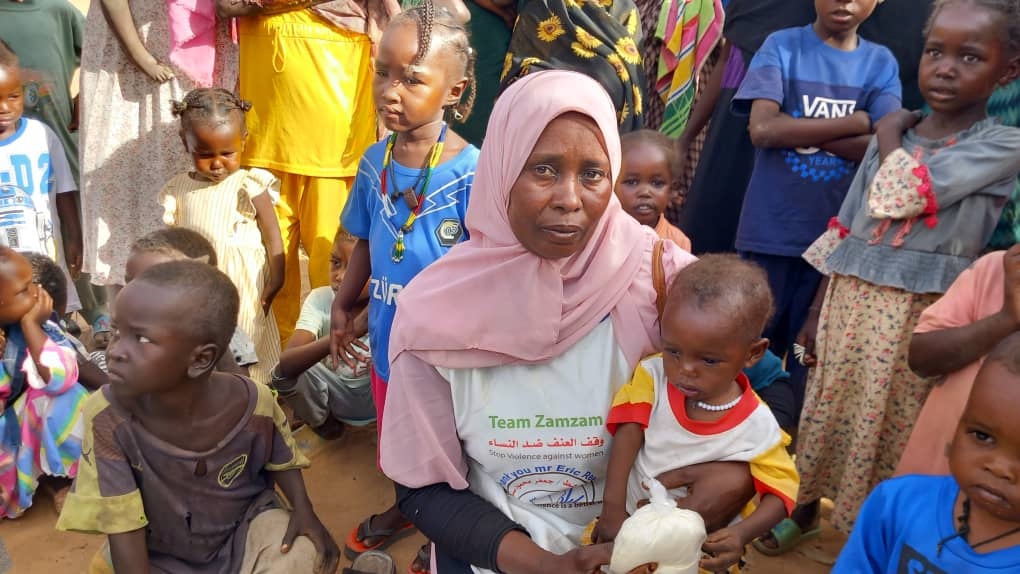
Refugee shelters in the Chadian border town of Tine are experiencing extremely dire humanitarian conditions. Refugees face severe food shortages and a continuous deterioration in health conditions, alongside the spread of chronic diseases and widespread malnutrition, particularly among children. A significant number of children suffering from acute malnutrition have been observed, posing an immediate threat to their lives.
At the same time, the level of humanitarian assistance provided by international organizations remains insufficient compared to the steadily increasing influx of refugees. Displacement continues daily as a result of ongoing attacks on villages by the Rapid Support Forces. Local organizations and community-based groups are also facing considerable constraints due to limited resources and operational capacity, preventing them from meeting even the most basic needs.
Despite the presence of United Nations agencies, current response efforts fall short of the scale of the crisis. This gap has contributed to growing frustration and resentment among refugees, many of whom perceive inequities in the response to their humanitarian situation.
[2] Team Zamzam Activities During the Reporting Period
During the reporting period, Team Zamzam sustained its humanitarian interventions to support refugees and alleviate their suffering through targeted food assistance and psychosocial support programs.
- Group Meals Program
The Team provided hot meals to 7,351 beneficiaries, with children under the age of twelve accounting for more than two-thirds of recipients. The program also targeted pregnant women suffering from malnutrition and elderly individuals.
Meals were prepared through a collective kitchen and included:
Meat-based pasta dishes
Rice cooked with meat
The program was implemented over three weeks, with an average frequency of three distributions per week.
- Children’s Breakfast Program
In parallel, Team Zamzam implemented a dedicated feeding program for malnourished children. Breakfast meals included:
Milk
Biscuits
Dumplings
This program was conducted three times per week during the reporting period, reaching more than 2,714 children.
- Household Food Distribution
A targeted food distribution was carried out for the most vulnerable households. Each family received:
3 kg of flour
2 pounds of sugar
1 kg of red lentils
1 bar of washing soap
A total of 116 families benefited from this initiative
- Psychosocial Support and Community Engagement
Psychosocial support activities continued throughout the reporting period. Counsellors provided assistance to survivors of sexual violence and worked closely with local volunteers and shelter representatives to design and implement recreational and stress-relief activities for children.
- Counseling and Assessment
The Team carried out:
16 group counseling sessions and 42 individual sessions
A total of 42 trained volunteers currently support counseling efforts
The number of individuals accessing counseling services continues to rise, with noticeable. improvements in recovery outcomes. This progress is partly due to the active engagement of beneficiaries, some of whom have transitioned into volunteer roles within the program.
More than 20 monitoring visits were carried out across shelters to gather feedback and assess needs.
Conclusion and Urgent Appeal
The onset of the rainy season has significantly exacerbated the already critical humanitarian situation. Sudanese refugees in the area are facing increasingly urgent needs, including access to food, safe drinking water, essential medicines, healthcare services, and other basic necessities.
Particular attention must be given to shelter; waterproofing residential tents is critically needed to protect vulnerable populations from heavy rains and flooding.
In anticipation of potential emergencies, Team Zamzam has procured approximately 14 tents as an initial preparedness measure; however, this remains far below the actual level of need.
Team Zamzam respectfully calls upon international organizations and humanitarian actors to take immediate, coordinated, and scaled-up action. Without a rapid response, the continued deterioration of conditions may soon exceed the capacity for effective intervention.
Please help support these efforts:
Operation Broken Silence, working primarily on health and education issues in the Nuba Mountains of South Kordofan, has created a special site for tax-deductible contributions to our project, and we hope this makes contributing to the health and well-being of the people served by Team Zamzam easier for donors.