Sudan Becomes the World’s Hungriest Country as Famine Spreads to Two New Areas of Darfur
Action Against Hunger, February 5, 2026
Famine in Sudan
Sudan is facing the world’s worst famine. Catastrophic food insecurity has spread to four areas and threatens 20 more. Over four million people are expected to suffer from acute malnutrition this year, and the country’s health system has virtually collapsed. Action Against Hunger is responding in hunger hotspots, but funding shortfalls threaten overall humanitarian response to the crisis.
• New data from the Integrated Food Security Phase Classification confirms that famine in Sudan, already present in two regions, has spread to two new locations in North Darfur. Sudan now has the most areas of active famine on the planet.
• More than 375,000 people are at real risk of starvation.
• The hunger crisis is occurring in a context of mass displacement, health system collapse, cholera outbreaks, and lack of humanitarian access.
• There is a severe lack of funding: the humanitarian response plan for Sudan in 2026, which needs $2.9 billion, has so far received only 5.5% of the necessary funds.
Action Against Hunger is present in the hunger hotspots of Darfur, White Nile, Blue Nile, Kordofan and Red Sea through programs focusing on health and nutrition, food security and livelihoods, water, sanitation and hygiene, and gender and protection.
Press release: Madrid/New York, 02/05/2026
Famine—the most extreme form of food crisis and a condition that is only declared in exceptional situations—is spreading in Sudan. Integrated Food Security Phase Classification (IPC) data released today confirm that two new areas in North Darfur, Um Baru and Kernoi, have now exceeded famine thresholds (Phase 5, the most severe IPC phase).
Until now, there were only three officially declared famines in the world: two in Sudan (El Fasher and Kadugli, confirmed in 2025) and one in Gaza. With this latest update, Sudan becomes the country with the most territories in active famine on the planet.
More than half of children in Um Baru suffer from acute malnutrition, while 34% do so in Kernoi. These figures raise fears that around 20 other areas are experiencing an equally critical situation. According to IPC data from last November, more than 375,000 people are in a catastrophic situation, and today it is predicted that more than 4 million people will suffer from acute malnutrition this year.
“Famine does not happen overnight. It is the result of months of siege, violence, and neglect. In Darfur, we are seeing entire communities left with nothing: no food, no aid, nothing,” explains Samy Guessabi, director of Action Against Hunger in Sudan.
An Unprecedented Humanitarian Crisis
The spread of famine comes amid what is already the world’s largest displacement crisis: 9.6 million people have been forced to flee their homes within the country. In El Fasher alone, more than 1.2 million people have left the area since the end of 2025. Another 4 million Sudanese have been forced to flee to neighboring countries such as Chad and South Sudan to survive.
At the same time, there is hardly any drinking water, and health systems have virtually collapsed: 80% of health facilities are damaged or out of service. Outbreaks of cholera, measles, and diarrhea are multiplying, especially in camps for displaced people without access to safe water or sanitation. “Families are eating once a day or nothing at all. Many survive on boiled leaves or animal feed. This is not a food crisis: it is a survival crisis,” adds Guessabi.
No Access, No Funds, No Time
Humanitarian access remains extremely limited in Sudan, especially in Darfur and Kordofan, due to conflict, blockades, insecurity and administrative obstacles. In some areas, humanitarian teams cannot even enter. Added to this is a severe lack of funding: the humanitarian response plan for Sudan in 2026, which needs $2.9 billion, has so far received only 5.5% of the necessary funds. Without an urgent response, mortality will increase dramatically in the coming months, especially during the upcoming lean season and rains.
Action Against Hunger calls for an immediate ceasefire, unrestricted humanitarian access and urgent mobilization of funds to prevent famine from spreading further across Sudan. Meanwhile, our teams on the ground continue to provide vital assistance in Blue Nile, Darfur, Red Sea, Kordofan and White Nile through health and nutrition, food security and livelihoods, water, sanitation and hygiene, and gender and protection programs. “Famine is not inevitable. It is a collective decision: either we act now, or we accept that thousands of people will die from something as basic as not having enough to eat,” concludes Guessabi.
In Sudan, sick and starving children “wasting away”
Thousands of people fled the North Darfur capital El Fasher last October when it was overrun by paramilitary Rapid Support Forces. They remain in makeshift camps in Tawila.
United Nations, 10 February 2026 | Peace and Security (Geneva
Relentless violence, famine and disease are fuelling a rising death toll among children in Sudan, while attacks on healthcare and a lack of aid access hamper efforts to help them, UN aid agencies warned on Tuesday. As heavy fighting continues between former allies the Sudanese Armed Forces and the paramilitary Rapid Support Forces and their allies, the UN Children’s Fund (UNICEF), said that in parts of North Darfur more than half of all children are acutely malnourished. The warning follows the release of new data from the IPC, a UN-backed global food security monitoring system, from three localities there – Um Baru and Kernoi and al-Tine – indicating “catastrophic” malnutrition rates.
“Extreme hunger and malnutrition come for children first, the youngest, the smallest, the most vulnerable,” said UNICEF spokesperson Ricardo Pires. “In Sudan, it’s spreading… These are children between six months and five years old, and they are running out of time.”
Starvation spreading
The UN agency stressed that famine thresholds have been surpassed in locations not previously considered at risk, such as Um Baru and Kernoi. Conflict, mass displacement, the collapse of services and blocked access which have sparked starvation alerts for these localities exist “across vast swathes of Sudan”, Mr. Pires insisted. “If famine is looming there, it can take hold anywhere,” he warned.
Mr. Pires also warned of the prevalence of disease as a further threat to children’s survival: “These children are not just hungry; nearly half of all children in al-Tiné had been sick in the previous two weeks. Fever, diarrhoea, respiratory infections, low vaccination coverage, unsafe water and a collapsing health system are turning treatable illnesses into death sentences for already malnourished children.” He called on the world to “stop looking away” from Sudan’s children, warning that more than half of the youngsters in North Darfur’s Um Baru are “wasting away while we watch”. “That is not a statistic. Those are children with names and a future that are being stolen,” the UNICEF spokesperson said.
Healthcare under attack
Dr Shible Sahbani, the UN World Health Organization (WHO)’s representative in Sudan, told reporters that while the displaced require “urgent” care, the health system has been “ravaged by attacks, loss and damage of equipment and supplies, a shortage of health workforce and operational funds.” Since the start of the war in April 2023, WHO has verified 205 attacks on health care that have led to 1,924 deaths and 529 injuries, Dr Sahbani said.
“Such attacks deprive communities of care for years to come, instilling terror in patients and health workers and creating unsurmountable barriers to life-saving treatment,” he added. Meanwhile, the country faces multiple disease outbreaks, including cholera, malaria, dengue and measles. While WHO and partners are supporting the response to these outbreaks, Dr. Sahbani insisted on the need for greater access and protection of health workers and facilities, in line with international humanitarian law. “Patients and healthcare workers should not risk death while seeking and providing care,” he said. “Above all, we call for peace…Peace is long due for Sudan.”
His call echoed that of UN High Commissioner for Human Rights Volker Türk, who on Monday once again sounded the alarm over the deadly conflict in Sudan, briefing the Human Rights Council in Geneva on the “preventable human rights catastrophe” that took place in North Darfur’s capital El Fasher in October last year. Thousands of people were killed there in a matter of days after an 18-month-long siege of the city, multiple testimonies gathered by Mr. Türk’s office have indicated.
[The figure is approximately 6,000 civilians in three days, according to the BBC, citing a UN report: https://www.bbc.com/news/articles/c043753z7w3o —ER]
Sudan: UN rights chief says worse is to come without international action
UNFPA (UN’s lead agency for sexual and reproductive health and rights) | 9 February 2026 Peace and Security
As the brutal Sudan war shows no signs of ending, UN human rights chief Volker Türk on Monday called on the international community to intervene immediately to stop more mass killings and other flagrant war crimes against civilians. “We can only expect worse to come” unless action is taken to halt the bloodshed, Mr. Türk told Member States at the Human Rights Council in Geneva, as he reiterated his call for the extension of an arms embargo from Darfur to include all of Sudan. Rival militaries from the national army and Rapid Support Forces (RSF) militia have been battling for control of the country for nearly three years.
Something must be done to address the “continuous inflow of weapons,” the High Commissioner for Human Rights insisted, after recounting testimonies of survivors of atrocity crimes in El Fasher, the capital of North Darfur, by paramilitary Rapid Support Forces (RSF) who overran the city last October.
Mass killings
“In one horrific example, people who fled to separate locations, thousands of kilometres apart, gave consistent accounts of the mass killing of hundreds of people sheltering at El Fasher University,” he said, describing convincing testimony that some victims were targeted based on their non-Arab ethnicity – in particular, members of the Zaghawa ethnic group.
“Survivors also spoke of seeing piles of dead bodies along roads leading away from El Fasher, in an apocalyptic scene that one person likened to the Day of Judgment,” the High Commissioner continued, his comments echoing the International Criminal Court’s (ICC) conclusion last month that war crimes and crimes against humanity had taken place in El-Fasher, linked to the RSF’s siege. “Our own findings are fully consistent” with that ICC assessment, Mr. Türk told the Human Rights Council, at a meeting held specifically on the Sudan emergency.
Dire warnings
Previously, the UN rights chief noted that his office has warned about previous atrocity crimes such as the RSF offensive to capture Zamzam camp for displaced people in April 2025. “Responsibility for these atrocity crimes lies squarely with the RSF and their allies and supporters,” he said. The war in Sudan erupted in April 2023, after a power-sharing agreement broke down in the resource-rich central African nation between the Sudanese Armed Forces (SAF) and the RSF.
The resulting humanitarian emergency has affected more than 30 million people in Sudan; many have faced repeated displacement and others have been impacted by famine and systematic sexual violence, including gang rape. As the fighting continues away from the Darfurs in the west to the central Kordofans regions, observers fear that further grave abuses are bound to happen, including by “advanced drone weaponry systems used by both sides”, Mr. Türk warned.
Deadly drone war
“In the last two weeks, the SAF and allied Joint Forces broke the sieges on Kadugli and Dilling,” the High Commissioner said. “But drone strikes by both sides continue, resulting in dozens of civilian deaths and injuries. Civilians are at risk of summary executions, sexual violence, arbitrary detention, and family separation.”
Deepening starvation in Sudan
CARE | February 5, 2026 – Joint NGO statement following IPC alert on Sudan
February 5, 2026 – The Integrated Food Security Phase Classification Partnership (IPC) alerts today of famine-level acute malnutrition detected in two more localities in North Darfur, Um Baru and Kernoi. Just three months ago, the IPC warned that famine was ongoing in Darfur and Kordofan states, with a high risk that these conditions would further spread.
The newly identified levels of acute malnutrition represent extreme, life-threatening deprivation, and famine may soon be confirmed by the IPC in these additional areas. For small children, the danger is especially acute: malnutrition gravely weakens their immunity, leaving them far more vulnerable to disease at a time when healthcare and other services have been severely disrupted, if not collapsed entirely. We know from global experience that famine confirmations often come too late. Thousands may have already died, and many surviving children are likely to face lifelong damage.
This new alert confirms what communities and responders have been fearing for months. Starvation is rising, and becoming entrenched in areas humanitarian actors are prevented from accessing. Even in places where we can operate, resources are drastically insufficient to meet overwhelming needs and halt the spread of hunger.
CARE, along with 21 international humanitarian organizations, warn that other areas are likely to be facing similar catastrophic conditions. Yet escalating conflict and severe access restrictions prevent comprehensive assessments and timely response. For nearly three years, armed actors in Sudan have conducted deliberate attacks on civilians and civilian infrastructure essential for survival. Sudan is also the site of a relentless war on women and girls, who continue to face systematic conflict-related sexual violence. This violence has displaced millions from their homes and livelihoods, devastated people’s ability to produce and distribute food, and routinely blocked their access to water, healthcare and protection services.
Restricted humanitarian access, continued funding shortfalls and insufficient political will are converging into a catastrophe that should never have been allowed to unfold. Without immediate and unhindered access for humanitarian operations, alongside a rapid increase in resources, including to local actors, the spread of starvation will not cease.
EDITOR’S NOTES
List of INGOs: Action Against Hunger (ACF), Africa Humanitarian Action (AHA), CARE, Concordis, Cooperazione Internazionale (COOPI), DanChurchAid (DCA), Danish Refugee Council (DRC), Humanity & Inclusion (HI), International Rescue Committee (IRC), LM International, MedGlobal, Medical Teams International (MTI), Mercy Corps, Norwegian Church Aid (NCA), Norwegian Refugee Council (NRC), Plan International, Relief International (RI), Save the Children, Solidarités International (SI), Trócaire, Vétérinaires Sans Frontières (VSF), and World Vision.
Sudan remains the world’s largest hunger, protection and displacement crisis, with over 33 million people in urgent need of humanitarian assistance and over 9 million displaced internally. Nearly 29 million people are acutely food insecure (61.7% of the population) Almost 10.2 million people fall into the severe and extreme categories of food insecurity, levels associated with extreme hunger, malnutrition and death.
Women are disproportionately affected: female-headed households are three times more likely to be food insecure than those led by men. Acute malnutrition for children aged 6-59 months and pregnant and breastfeeding women is expected to deteriorate in 2026, with nearly 4.2 million estimated cases of acute malnutrition, including more than 800,000 cases of severe acute malnutrition (SAM). This number is expected to rise as the situation continues to deteriorate.
Barely 40% of the required funding to address the humanitarian crisis was secured in 2025
57%, more than half of the displaced people who are suffering from hunger do not receive aid due to lack of funding.
Sudan: UN rights chief says worse is to come without international action
UNFPA (UN’s lead agency for sexual and reproductive health and rights), 9 February 2026 | Peace and Security
As the brutal Sudan war shows no signs of ending, UN human rights chief Volker Türk on Monday called on the international community to intervene immediately to stop more mass killings and other flagrant war crimes against civilians. “We can only expect worse to come” unless action is taken to halt the bloodshed, Mr. Türk told Member States at the Human Rights Council in Geneva, as he reiterated his call for the extension of an arms embargo from Darfur to include all of Sudan.
Rival militaries from the national army and Rapid Support Forces (RSF) militia have been battling for control of the country for nearly three years. Something must be done to address the “continuous inflow of weapons”, the High Commissioner for Human Rights insisted, after recounting testimonies of survivors of atrocity crimes in El Fasher, the capital of North Darfur, by paramilitary Rapid Support Forces (RSF) who overran the city last October.
Mass killings
“In one horrific example, people who fled to separate locations, thousands of kilometres apart, gave consistent accounts of the mass killing of hundreds of people sheltering at El Fasher University,” he said, describing convincing testimony that some victims were targeted based on their non-Arab ethnicity – in particular, members of the Zaghawa ethnic group. “Survivors also spoke of seeing piles of dead bodies along roads leading away from El Fasher, in an apocalyptic scene that one person likened to the Day of Judgment,” the High Commissioner continued, his comments echoing the International Criminal Court’s (ICC) conclusion last month that war crimes and crimes against humanity had taken place in El-Fasher, linked to the RSF’s siege. “Our own findings are fully consistent” with that ICC assessment, Mr. Türk told the Human Rights Council, at a meeting held specifically on the Sudan emergency.
Dire warnings
Previously, the UN rights chief noted that his office has warned about previous atrocity crimes such as the RSF offensive to capture Zamzam camp for displaced people in April 2025. “Responsibility for these atrocity crimes lies squarely with the RSF and their allies and supporters,” he said.
As the fighting continues away from the Darfurs in the west to the central Kordofans regions, observers fear that further grave abuses are bound to happen, including by “advanced drone weaponry systems used by both sides”, Mr. Türk warned. “In the last two weeks, the SAF and allied Joint Forces broke the sieges on Kadugli and Dilling,” the High Commissioner said. “But drone strikes by both sides continue, resulting in dozens of civilian deaths and injuries. Civilians are at risk of summary executions, sexual violence, arbitrary detention, and family separation.”
EU official warns of catastrophic Sudan crisis as millions face starvation
Sudan Tribune | 11 FEBRUARY 2026 (Strasbourg)
The European Union’s humanitarian chief warned on Tuesday that Sudan’s conflict has reached a “beyond catastrophic” level, with more than 33 million people requiring aid as the war surpasses 1,000 days. Addressing the European Parliament, Commissioner Janez Lenarčič, represented by Commissioner Hadja Lahbib, described the situation as a “brutal power struggle for resources sustained by armed actors who show no mercy for civilian life”. The Commissioner highlighted recent atrocities in Darfur, specifically citing “horrendous attacks” by the Rapid Support Forces (RSF) during their capture of El Fasher late last year. The violence has turned the town [should be Tawila Locality—ER] of Tawila into the world’s largest internal displacement camp, now hosting over 700,000 people.
Despite the scale of the crisis, Lahbib noted that “only an estimated 15%-30% of needs are currently being met” in the camp. “Humanitarian space continues to shrink in Sudan, which is one of the deadliest places in the world for aid workers,” Lahbib said, pointing to bureaucratic barriers used to block assistance. The EU official also criticized regional powers for fuelling a “proxy war” while publicly calling for peace, urging international mediators to exert more concrete influence over the warring factions. The EU has allocated nearly 700 million euros for the crisis between 2023 and 2025, using air bridges and sea freight to deliver relief
Child malnutrition hits catastrophic levels in parts of Sudan ; Latest IPC projections indicate catastrophic rise in severe food insecurity in many parts of Sudan
UN News | Global perspective Human stories (February 5, 2026)
https://news.un.org/en/story/2026/02/1166898
Acute malnutrition among children has reached catastrophic levels in parts of Sudan’s North Darfur and Greater Kordofan, UN-backed analysts warned on Thursday, as conflict, mass displacement and denials of aid push the country deeper into a famine-risk emergency. According to an alert from the IPC, a global food security monitoring system, thresholds for acute malnutrition were surpassed in two new areas of North Darfur – Um Baru and Kernoi – following the fall of the regional capital, El Fasher, in October 2025 and a massive exodus.
December assessments found acute malnutrition levels among children of 52.9 per cent in Um Baru – nearly twice the famine threshold – and about 34 per cent in Kernoi. The IPC stressed that the alert does not constitute a formal famine classification but warned that conditions are deteriorating rapidly – and action is urgently needed. “These alarming rates suggest an increased risk of excess mortality,” the experts said, adding that many other conflict-affected or inaccessible areas may be facing similarly catastrophic conditions.
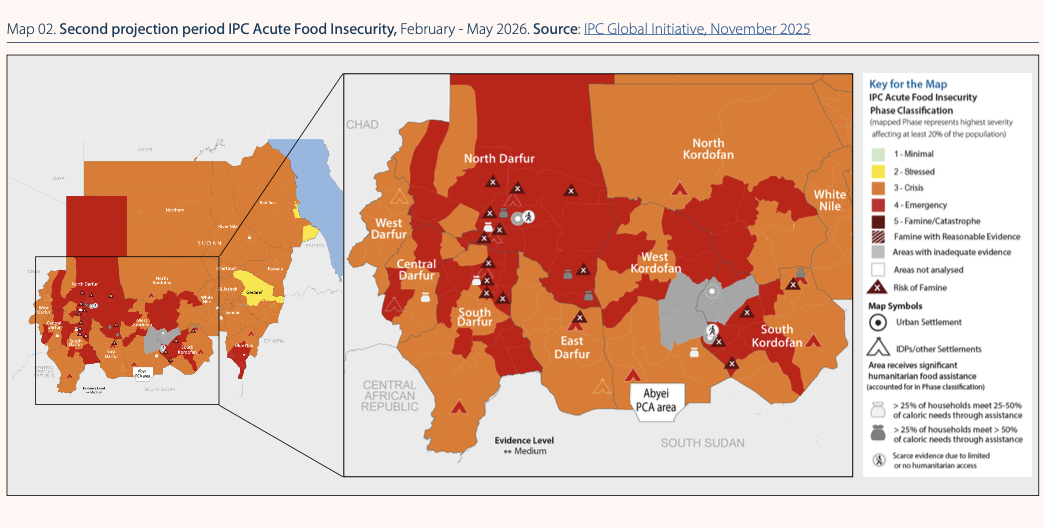 Source: IPC–Projection acute food insecurity in Sudan from February to May 2026.
▶ See our UN News explainer on the evidence-based IPC index here.
Um Baru and Kernoi
Um Baru and Kernoi are in remote areas of northwestern North Darfur, near key displacement corridors leading toward the Chadian border. Both areas have absorbed large numbers of civilians fleeing fighting in and around El Fasher, where conflict has shattered markets, disrupted livelihoods and sharply curtailed humanitarian access. Sudan’s war, which erupted in April 2023 between the once-allied Sudanese Armed Forces (SAF) and the Rapid Support Forces (RSF), has devastated food systems nationwide, triggering mass displacement, market collapse and repeated disruptions to health, water and nutrition services.
Across the country, nearly 4.2 million cases of acute malnutrition are now expected in 2026, including more than 800,000 cases of severe acute malnutrition, representing a sharp increase from 2025 levels, according to IPC projections.
What the alert means
The IPC alert is intended to draw urgent attention to the worsening conditions and does not introduce any new formal classification. It builds on earlier IPC analyses that confirmed famine (IPC Phase 5) in El Fasher, North Darfur in 2024, and Kadugli, South Kordofan, in September 2025 – and projected famine risk in at least 20 other areas across greater Darfur and greater Kordofan.
The new findings indicate that famine-like conditions are likely spreading beyond previously assessed locations, driven by continued fighting, displacement and the collapse of food, health and water systems, IPC analysts said.
Greater Kordofan at risk
The IPC also warned of rapidly deteriorating conditions across Greater Kordofan, where famine was already confirmed in Kadugli and severe conditions were projected in Dilling and the Western Nuba Mountains. Renewed fighting since late October has displaced more than 88,000 people in the region, pushing total displacement above one million. Markets there are among the least functional in Sudan, with food prices far above national averages. Without an immediate end to the fighting and large-scale humanitarian access, IPC experts said preventable deaths are likely to rise.
US and UN launch a humanitarian fund with $700 million for war-ravaged Sudan
Associated Press, February 5, 2026. CAIRO
https://apnews.com/article/sudan-famine-rsf-kordofan-darfur-war-hunger-9b16a0419f8d7cc67c7e95939a8a954d
Famine is threatening more areas in war-torn Sudan’s western Darfur region, a global hunger monitoring group said Thursday as an attack by paramilitary forces on a military hospital in the country’s south killed 22 people, including the hospital’s director and three members of its medical staff. Since April 2023, Sudan has been in the throes of war after a power struggle erupted between the military and the powerful paramilitary Rapid Support Forces, or RSF. The conflict has triggered what the United Nations calls the world’s worst humanitarian crisis.
The Integrated Food Security Phase Classification, or IPC, released a new report saying that acute malnutrition has reached famine levels in two more towns in Darfur. It stopped short of confirming a full famine in the towns. Last year, the group said that people in Darfur’s major city of el-Fasher, overrun by the paramilitary forces after an 18-month siege, were enduring famine. The attack Thursday in the town of Kouik in South Kordofan province, also left eight people wounded, the Sudan Doctors’ Network, a group of medical professionals tracking the war said. It was not immediately clear how many of the casualties were civilians.
Drone attack by paramilitary group in Sudan kills 24, including 8 children, doctors’ group says.
The attack was “not an isolated incident, but rather part of a series of attacks that have plagued South Kordofan,” the network said, adding that the assaults have left “several hospitals inoperable.” The U.N. estimates that over 40,000 people have been killed in the war in Sudan, but aid agencies consider that the true number could be many times higher. Over 14 million people have been forced to flee their homes.
A harrowing report
The IPC report said famine-level malnutrition has been registered in the towns of Umm Baru and Kernoi in North Darfur province. In November, the group said that along with el-Fasher, the city of Kadugli in South Kordofan was also enduring famine. At the time, it also said 20 other areas across Sudan were at risk of famine.
In Umm Baru, nearly 53% of children between aged between 6 months and nearly 5 years suffered from acute malnutrition, the IPC said — almost double the famine threshold, which stands at 30%. In Kernoi, 32% of children are suffering from malnutrition, the group said. “These alarming rates suggest an increased risk of excess mortality and raise concern that nearby areas may be experiencing similar catastrophic conditions,” the report said. Since the eruption of Sudan’s civil war, the IPC has confirmed famine in a total of seven areas. The group said it could not confirm a full famine in Umm Baru and Kernoi as access and lack of data makes it difficult to confirm the other two thresholds — access to food and mortality — that need to be reached for a famine to be confirmed.
The fall of el-Fasher in October 2025 to the RSF set off an exodus of people to nearby towns, straining the resources of neighboring communities and driving up food insecurity rates, the report said. The IPC has confirmed famine only a few times, most recently in 2025 in northern Gaza during the Israel-Hamas war. It also confirmed famine in Somalia in 2011, and in South Sudan in 2017 and 2020.
In 2024, famine had struck five other areas in North Darfur and also Sudan’s Nuba Mountains region.
The IPC report also warned that more people might face extreme hunger in Kordofan, where the conflict has disrupted food production and supply lines in besieged towns and isolated areas. “An immediate and sustained ceasefire is critical to avert further destitution, starvation, and death in the affected parts of Sudan,” pled the Rome-based group.
According to experts, famine is determined in areas where deaths from malnutrition-related causes reach at least two people, or four children under 5 years of age, per 10,000 people; at least one in five people or households severely lack food and face starvation; and at least 30% of children under age 5 suffer from acute malnutrition based on a weight-to-height measurement — or 15% based on upper-arm circumference.
Fighting rages on
Since the RSF overran el-Fasher, which had been one of the army’s last strongholds in Darfur, fighting has recently concentrated in various areas of Kordofan. Lately, the Sudanese military began making gains in Kordofan after breaking a siege in Kadugli and the neighboring town of Dilling.
On Tuesday, the Sudanese military announced that it had opened a crucial road between Dilling and Kadugli, which had been under siege by the RSF since the start of the war. The RSF launched a drone attack Tuesday that hit a medical center in Kadugli, killing 15 people including seven children, according to Sudan Doctors Network.
Also this week, the United States and the U.N. said they are seeking to rally international support for humanitarian aid to Sudan, kicking off a new Sudan Humanitarian Fund with $700 million in contributions from the United Arab Emirates and the U.S. The Trump administration said Tuesday it would contribute $200 million to the initiative from a basket of $2 billion it set aside late last year to fund humanitarian projects around the world. The UAE said it would contribute $500 million. Saudi Arabia and several other participants promised they would make pledges but did not specify amounts.
Civilians and aid operations under fire as Sudan airstrikes intensify
United Nations | 11 February 2026 | Peace and Security
Escalating aerial attacks in Sudan are killing children, damaging schools and striking United Nations facilities, placing civilians and humanitarian workers at growing risk, the UN warned on Wednesday.
Two children were reportedly killed and 13 others injured in a drone strike on a mosque in Al-Rahad, North Kordofan, where all the victims were students at the adjoining school. The attack came just hours after a primary school in Dilling, South Kordofan, was hit, with further injuries reported.
[Both attacks have been authoritatively attributed to the RSF, something the UN typically finds itself unable to say, even if there is no doubt—ER]
WFP warehouse hit
The warehouse of the UN World Food Program (WFP) in the South Kordofan capital, Kadugli, also was struck by suspected rockets, significantly damaging buildings and mobile storage units. Recent days have also seen drone strikes reported in other parts of South Kordofan, North Kordofan and West Kordofan states, UN Spokesperson Stéphane Dujarric told journalists in New York. Strikes have occurred close to key supply routes linking the city of El Obeid in North Kordofan to Dilling and Kadugli in South Kordofan, and this is endangering civilians, including humanitarian workers.
[Only the RSF has incentive for these attacks—ER]
Not a target
“The fact that we have to reiterate almost every day that civilians and civilian infrastructure, places of worship, schools and hospitals cannot and should not be targeted is a tragedy into itself,” he said. “Yet, we have to remind the parties of this almost every day and that they need to respect international humanitarian law.”
Malnutrition reaches famine levels in two more areas of Sudan’s North Darfur, monitor says
Reuters (GENEVA/CAIRO), February 5, 2026
Acute malnutrition has reached famine levels in two more areas of North Darfur, Sudan, a global hunger monitor said on Thursday, amid a civil war that has displaced millions and triggered waves of ethnically charged violence. The U.N.-backed Integrated Food Security Phase Classification (IPC) found that famine thresholds for acute malnutrition have been surpassed in Um Baru – where the rate of acutely malnourished children aged under five was nearly double the famine threshold, and Kernoi.
The IPC alert is not a formal famine classification, but it highlights alarming levels of hunger based on the latest data. The two localities near the border with Chad received some of the tens of thousands who fled the district of al-Fashir – previously determined to be in famine – late last year when it fell to the Rapid Support Forces. Kernoi and Um Baru then saw clashes as the RSF sought to consolidate control. Cases of acute malnutrition are rising in the country, with nearly 4.2 million estimated cases compared to 3.7 million in 2025, the IPC stated.
FUNDING AND ACCESS CHALLENGES
Limited access to lifesaving health services across North Darfur has compounded the problem, the IPC stated. In Kernoi, only 25% of children suffering from Severe Acute Malnutrition were enrolled in treatment programmes, while in Greater Kordofan, conflict has severely disrupted food production and supply lines, according to the IPC.
One of the major aid groups operating in Sudan, CARE International, told Reuters that their ability to respond was also being limited by global donor funding cuts. “Starvation has really become entrenched in some of the places where we’re working,” CARE’s Humanitarian Advocacy Advisor, Elizabeth Courtney, told Reuters. Funding is urgently needed to scale up supplies ahead of the rainy season and lean season, when food stocks from the previous harvest are low or depleted, Courtney said
Sudan: Countdown to catastrophe in Kordofan, as world once again looks away
Norwegian Refugee Council | Press release: 02 Feb 2026
South Kordofan is now the epicentre of the war in Sudan, which has caused the world’s largest humanitarian crisis. Civilians in this part of southern Sudan face intensified fighting and near-total blockage of humanitarian supplies, after a year of starvation and bombardment, the Secretary General of the Norwegian Refugee Council (NRC) Jan Egeland warned today.
At the end of his visit to South Kordofan, Egeland said he saw that the world was once again failing civilians in Sudan, with the clock ticking on further widespread atrocities. “South Kordofan has become Sudan’s most dangerous and neglected frontline,” said Egeland. “After the horrors in Al Fasher, Darfur, we cannot allow another civilian catastrophe to unfold on our watch. Entire cities are being starved, forcing families to flee with nothing. Civilians here have told me they are bombed and attacked where they live, pray, and learn. This is a man-made disaster, and it is accelerating towards a nightmare scenario.”
In Kadugli and Dilling, the main towns in South Kordofan, essential supply routes have been cut, leading markets to completely collapse. Trapped civilians are left with little or no access to food, cash, or basic services. Famine is taking hold in Kadugli, with Dilling at high risk of the same.
During the visit, Egeland met families who fled only after survival became impossible. Asia fled Kadugli last December with her four young children, including a seven-month-old baby, after their home was hit by explosives, while her husband was away searching for food. “I had to carry my baby in my arms and run with my other kids to save our lives,” said Asia. “Here in Thobo Camp I still have no news of my husband and have to collect firewood and straw in the fields to sell for food. I still want to stay in the camp because here my children can attend the NRC school.”
Thousands of people are now fleeing Kordofan in small, desperate journeys, often having to navigate across frontlines, heading toward the Nuba Mountains – a region long isolated and impoverished, and now facing renewed violence. Others are fleeing to White Nile, Gedaref, and South Sudan. Journeys take days or weeks and are marked by hunger, theft, intimidation, and abuse. Upon reaching the relative safety of displacement camps, families sleep on the bare ground or in overcrowded shelters. Aid groups like NRC are few, over-stretched, and under-funded. Essential items are critically scarce.
Children are traumatised, malnourished, and out of school. Parents tell NRC that psychosocial support, education, and cash assistance are among their most urgent needs. Egeland warned that the humanitarian response is nowhere near the scale required, as international agencies remain largely absent and access constraints continue to block aid delivery. “With most international organisations’ operations scaled back, Sudanese local responders are holding the line under extreme pressure,” said Egeland. “They are running communal kitchens, evacuating families, and delivering aid under fire. They are doing everything possible, bu we must do more to help them.”
NRC is maintaining operations in Kadugli, the Nuba Mountains and other areas where people flee to, despite severe security and access constraints, and is supporting emergency food, cash, shelter, education, protection and water supply wherever possible. However, needs are rapidly outpacing available resources. “This is a critical moment,” said Egeland. “We know exactly where this leads if the world looks away again. History will judge us if we abandon the civilians of Sudan again to face endless violence and deprivation.”
NRC is appealing to the parties to the conflict for immediate humanitarian access and protection of civilians. It is calling for urgent funding for life-saving aid, and effective international engagement to prevent further suffering. “The people of Kordofan have not given up,” said Egeland. “Local responders have not given up. The question now is whether the world will finally act.”
Notes to editors:
- B-roll and photos are available for free use here.
- Kadugli is already assessed as facing famine-like conditions; Dilling is at high risk of the same (UN).
- All major supply routes into Kadugli and Dilling are cut.
- Markets are largely non-functional; food prices are extremely high and cash is scarce.
- Between 25 October and 15 January more than 88,000 people were displaced in the Kordofan region. The region currently hosts more than one million internally displaced persons (IOM). Displacement routes include the Nuba Mountains, White Nile, Gedaref and South Sudan, often across active frontlines.
- No UN presence remains in Kadugli; most international NGOs have suspended or drastically reduced operations.
- Local responders are often the only providers of assistance still operating on the ground.
- NRC continues operations in Kadugli, Dilling, the Nuba Mountains and displacement areas, supporting community kitchens; with emergency water, sanitation and hygiene; supplying non-food items; and with education, in 29 learning centres. NRC is also prepositioning shelter and non-food item kits in White Nile and Gedaref in anticipation of further displacement.
- In 2025, 62 per cent of needs went unfunded. Only a fraction of total needs are likely to be met in 2026 (OCHA).s
Famine spreading in Sudan’s North Darfur, UN says
AFP, dpa | February 5, 2026 https://p.dw.com/p/58Awq
A brutal civil war between Sudan’s army and paramilitary forces is causing one of the world’s worst humanitarian crises, the UN has said.
Famine is spreading in North Darfur in western Sudan, United Nations-backed monitors said Thursday. Millions of people in Sudan have been facing malnutrition since a civil war began in April 2023. The conflict between the Sudanese army and the paramilitary group Rapid Support Forces (RSF) has killed tens of thousands of people and displaced nearly 11 million, triggering what has been described as the world’s worst humanitarian crisis.
What did the IPC report say?
In a report published on Thursday, the UN‘s Integrated Food Security Phase Classification (IPC), global food security experts said “famine thresholds for acute malnutrition have now been surpassed” in Um Baru and Kernoi, contested areas near the Chad border. The IPC, which is used by the UN’s Food and Agriculture Organization (FAO), said malnutrition in Um Baru was nearly double the famine threshold. “These alarming rates suggest an increased risk of excess mortality and raise concern that nearby areas may be experiencing similar catastrophic conditions,” the IPC report said.
Millions in need of aid are cut off
Humanitarian access across the war-torn country remains severely restricted, the monitors also said.
“The remaining population in el-Fasher town is largely inaccessible, meanwhile escalating conflict along the Sudan-Chad border threatens to compromise the essential supply route from Chad, cutting off millions in need of assistance across Greater Darfur,” it said.
The famine has worsened since the RSF takeover of el-Fasher, the capital of North Darfur, and the “massive displacement” of civilians which was “driving up acute food insecurity and malnutrition,” the report said. El-Fasher, once the army’s last stronghold in western Darfur, fell to the paramilitary group in October after an 18-month siege. After the city fell, reports of mass killings, abductions and rape began to emerge. The UN says at least 127,000 people fled to towns in the area.
Famine also spreading to Kordofan
Famine conditions, which the IPC confirmed in El-Fasher and South Kordofan capital Kadugli nearly three months ago, are at risk of spreading to 20 more areas in Darfur and Kordofan, the report said.
Kordofan has become a key battleground in the fighting between the RSF and the army. Around 88,000 people have been displaced since October, the UN says. The capital South Kordofan, Kadugli, has been under an RSF siege for much of the war. In the town of Kouik in South Kordofan, an RSF attack on a hospital on Thursday killed 22 people and wounded eight others, according to the Sudan Doctors’ Network. The group said the strike was “part of a series of attacks that have plagued” the state and which have left “several hospitals inoperable.” Nearly half the population of Sudan — more than 21 million people — are facing acute food insecurity and lack adequate supplies, according to the UN. The IPC also says 4.2 million people are at risk of acute malnutrition this year.
Deepening starvation in Sudan
CARE | February 5, 2026 – Joint NGO statement following IPC alert on Sudan
February 5, 2026 – The Integrated Food Security Phase Classification Partnership (IPC) alerts today of famine-level acute malnutrition detected in two more localities in North Darfur, Um Baru and Kernoi. Just three months ago, the IPC warned that famine was ongoing in Darfur and Kordofan states, with a high risk that these conditions would further spread.
The newly identified levels of acute malnutrition represent extreme, life-threatening deprivation, and famine may soon be confirmed by the IPC in these additional areas. For small children, the danger is especially acute: malnutrition gravely weakens their immunity, leaving them far more vulnerable to disease at a time when healthcare and other services have been severely disrupted, if not collapsed entirely. We know from global experience that famine confirmations often come too late. Thousands may have already died, and many surviving children are likely to face lifelong damage.
This new alert confirms what communities and responders have been fearing for months. Starvation is rising, and becoming entrenched in areas humanitarian actors are prevented from accessing. Even in places where we can operate, resources are drastically insufficient to meet overwhelming needs and halt the spread of hunger.
CARE, along with 21 international humanitarian organizations, warn that other areas are likely to be facing similar catastrophic conditions. Yet escalating conflict and severe access restrictions prevent comprehensive assessments and timely response. For nearly three years, armed actors in Sudan have conducted deliberate attacks on civilians and civilian infrastructure essential for survival. Sudan is also the site of a relentless war on women and girls, who continue to face systematic conflict-related sexual violence. This violence has displaced millions from their homes and livelihoods, devastated people’s ability to produce and distribute food, and routinely blocked their access to water, healthcare and protection services.
Restricted humanitarian access, continued funding shortfalls and insufficient political will are converging into a catastrophe that should never have been allowed to unfold. Without immediate and unhindered access for humanitarian operations, alongside a rapid increase in resources, including to local actors, the spread of starvation will not cease.
EDITOR’S NOTES
List of INGOs: Action Against Hunger (ACF), Africa Humanitarian Action (AHA), CARE, Concordis, Cooperazione Internazionale (COOPI), DanChurchAid (DCA), Danish Refugee Council (DRC), Humanity & Inclusion (HI), International Rescue Committee (IRC), LM International, MedGlobal, Medical Teams International (MTI), Mercy Corps, Norwegian Church Aid (NCA), Norwegian Refugee Council (NRC), Plan International, Relief International (RI), Save the Children, Solidarités International (SI), Trócaire, Vétérinaires Sans Frontières (VSF), and World Vision.
Sudan remains the world’s largest hunger, protection and displacement crisis, with over 33 million people in urgent need of humanitarian assistance and over 9 million displaced internally. Nearly 29 million people are acutely food insecure (61.7% of the population) Almost 10.2 million people fall into the severe and extreme categories of food insecurity, levels associated with extreme hunger, malnutrition and death.
Women are disproportionately affected: female-headed households are three times more likely to be food insecure than those led by men. Acute malnutrition for children aged 6-59 months and pregnant and breastfeeding women is expected to deteriorate in 2026, with nearly 4.2 million estimated cases of acute malnutrition, including more than 800,000 cases of severe acute malnutrition (SAM). This number is expected to rise as the situation continues to deteriorate.
Barely 40% of the required funding to address the humanitarian crisis was secured in 2025
57%, more than half of the displaced people who are suffering from hunger do not receive aid due to lack of funding.
Crisis in Sudan: What is happening and how to help
International Rescue Committee | February 10, 2026
AT A GLANCE
- 8.8 million people have been internally displaced
- Over 4 million refugees have fled to neighboring countries
- 33.7 million people, two-thirds of the population, are in need of humanitarian aid
- More than 21 million people face high levels of acute food insecurity
Even before the war erupted in April 2023, Sudan was already experiencing a severe humanitarian crisis that left 15.8 million people in need of aid. Now, over 1000 days of war have drastically worsened these conditions, displacing over 12 million people and leaving 33.7 million people—approximately two-thirds—in need of humanitarian support. Sudan is the largest humanitarian crisis in the world. It is also the largest and fastest displacement crisis.
What do the people of Sudan face today?
Almost three years of civil war have decimated Sudan. Civilians are subject to frequent attacks and human rights violations, while the country’s health care system has collapsed as life-threatening famine sets in. Attacks on humanitarian aid workers have made it difficult to deliver lifesaving aid to some of the most fragile and vulnerable communities in the world.
Sudan’s civil war, waged between the Sudanese Armed Forces (SAF) and the Rapid Support Forces (RSF), erupted on April 15, 2023, plunging the country into chaos. Civilians bear the brunt of the conflict; sexual violence is widespread, fighters on both sides regularly target civilians and infrastructure, and child soldier recruitment is common. More than 150,000 people have been killed, with indiscriminate attacks on civilians being reported. With over 30 million people in need of humanitarian aid, Sudan accounts for a shocking 10% of global needs. Diplomacy is paralyzed as both SAF and RSF leaders have little incentive to do a deal since they and their regional backers continue to profit from Sudan’s war. Large quantities of gold flow out of the country, while increasingly advanced weapons move in the opposite direction.
What is happening in El Fasher, Darfur?
Needs are acute in Darfur: thousands of families have fled El Fasher, the state’s largest city, to neighboring Tawila in hopes of finding safety and accessing humanitarian services. Despite reports of large numbers of families attempting to flee toward Tawila, IRC teams on the ground have seen very few arrive—indicating that many may be dead, trapped, or facing severe risks along the route. IRC teams in Tawila spoke with people who recently arrived, who reported walking directly from El Fasher, traveling mostly at night on foot. Along the way, they witnessed numerous dead bodies scattered along the route and wounded individuals crying for help. More than 170 unaccompanied and separated children—many too young to state their names or origin—have arrived in Tawila without their parents or relatives.
“The sight of these small children arriving alone, without knowing the whereabouts or the fate of the rest of their family, is harrowing,” says Arjan Hehenkamp, IRC Darfur crisis lead. “Extremely disturbing reports and satellite imagery confirm that people are not able to flee el-Fasher to safe places like Tawila. Which means they are trapped, detained or worse.”
The war in Sudan has created extreme levels of displacement, both internally and across Sudan’s borders. More than 12 million people have been displaced since April 2023, including more than 4 million people—mostly women and children—who have fled to neighboring countries. While neighboring countries—such as Chad and South Sudan—have welcomed Sudanese refugees fleeing conflict, they lack the resources to meet the urgent humanitarian needs of those arriving across the border without international support. Meanwhile, U.S. aid cuts have deepened the crisis, forcing organizations to scale back some essential services to refugees, particularly in South Sudan.
The majority of displaced Sudanese, more than 8.8 million people, remain in the country, where they struggle to access clean water, food, health care and essential survival supplies. Famine conditions are spreading across Sudan as violence severely hinders humanitarians’ ability to deliver food where it’s needed most. Meanwhile, soaring food prices and a collapse of food supply have left families starving.
Violence and siege warfare have driven over 21 million people to high levels of acute food insecurity. Over 635,000 people, including those in the country’s largest camp for displaced people, are experiencing famine conditions and the daily risk of starvation. The severe food shortage also leaves people vulnerable to illness and infection due to a lack of essential nutrients.
More people are living in famine conditions in Sudan than the rest of the world combined.
“Behind these numbers are mothers, fathers and children whose lives are hanging by a thread,” explains IRC Country Director, Richard Data. “Without immediate, scaled-up humanitarian assistance, including cash, food, nutrition support, lifesaving health care, we risk seeing more communities fall into famine.”
A health system on the brink of collapse
The war in Sudan has devastated the country’s public infrastructure, including its health system. More than 70% of Sudan’s hospitals have been destroyed, leaving millions without access to essential medical care as disease outbreaks surge. With health care access severely limited, a cholera outbreak has spread across Sudan, resulting in more than 120,000 confirmed cases and over 3,000 deaths.
Women and children face heightened risks
The ongoing crisis in Sudan is taking a devastating toll on women and girls. The collapse of critical health care services has put new mothers at risk of losing their lives in the months ahead, as it has become nearly impossible to access essential reproductive care. The number of people at risk of Gender-based violence has tripled in two years. Reports of intimate partner violence, sexual exploitation, abuse and trafficking are widespread, while survivors struggle to access support. Economic hardship has stripped countless women of their livelihoods, forcing many into desperate and exploitative situations, and increasing their vulnerability.
In Darfur, alarming reports of sexual violence underscore the immense suffering endured by those in dire conditions, revealing the exceptional vulnerability of women and children.
“Worse to come” in Sudan as famine spreads and war continues
As the war grinds on well past 1,000 days, famine grips more and more areas in what is already the country with high levels of hunger
February 12, 2026 (People’s Dispatch)
“We can only expect worse to come” in Sudan if the war is not stopped, UN High Commissioner for Human Rights Volker Türk warned the Human Rights Council on February 9, as famine conditions expand in the country facing the highest levels of hunger in the world. Apart from Gaza, which has been suffering Israel’s genocidal war since October 2023, there are only two officially declared ongoing famines in the world – both in this North African country, in the throes of a civil war raging for nearly three years.
One of them is in South Kordofan State’s capital, Kadugli, gripped by famine since last September, following a prolonged siege by the Rapid Support Forces (RSF), fighting its former ally, the Sudanese Armed Forces (SAF), since April 2023. Also besieged further north was the state’s second largest city, Dilling, where hunger levels “are likely similar to Kadugli, but cannot be classified due to insufficient reliable data – a result of restricted humanitarian access and ongoing hostilities,” the UN had said.
Siege broken, but relief may be “temporary”
Earlier, on February 3, the SAF announced it had broken the siege on Kadugli, days after making a similar advance, taking control of the supply routes to Dilling in late January, reconnecting the two cities to North Kordofan. With the markets re-supplied, prices of essential food items in Kadugli have dropped to a fraction of what they had surged to under siege, Sudan Tribune reported on February 8.
However, the Famine Early Warning Systems Network (FEWS NET) had cautioned in its report on February 5 that the relief for its residents may only be “temporary”. It warned of the possibility “that Famine will persist through May in the absence of a ceasefire and sustained humanitarian access. It is expected that the towns will remain heavily contested, and the risk is high that renewed siege-like conditions will be re-established between February and May.”
Drone attacks on food trucks amid famine
Türk also highlighted this volatility in his briefing to the Human Rights Council on February 9. Although the SAF and its allied armed groups have broken the siege on these cities, “drone strikes by both sides continue, resulting in dozens of civilian deaths and injuries,” he added. Two days before, on February 7, the RSF had killed at least 24 people (including eight children, among them infants) with a drone strike on a humanitarian convoy transporting residents fleeing the fighting in South Kordofan State’s Dubeiker area to North Kordofan in the city of Rahad.
A day earlier, one was killed and many more wounded in the drone attack on a convoy of the World Food Program (WFP), en route to supplying aid to the displaced people sheltering in North Kordofan’s capital, El Obeid. Building earthen walls around El Obeid, the SAF is holding out against the RSF to defend this strategic city enroute to the national capital, Khartoum, from the Darfur region in western Sudan. The RSF has taken control over most of this region after overrunning North Darfur State’s capital, El Fasher, also in the throes of famine since last September.
“Mass atrocities committed in Darfur may repeat Kordofan”: warns the UN
After laying a siege for over 500 days and starving the residents of this last major city in the five states of Darfur holding against the RSF, the paramilitary overran its defenses in late October. Barely two months later, satellite imagery analysis by the Yale Humanitarian Research Lab (HRL) had confirmed that the city had been depopulated by the RSF after likely killing tens of thousands of its residents. “My Office sounded the alarm about the risk of mass atrocities in the besieged city of El Fasher for more than a year,” Türk added in his briefing, regretting, “The threat was clear, but warnings were not heeded.” He went on to warn, “I am extremely concerned that these violations and abuses may be repeated in the Kordofan region,” which has become the center of fighting since the fall of El Fasher.
Famine-conditions spread in Darfur
An estimated 127,000 people have managed to escape El Fasher and its surrounding areas, according to the International Organization for Migration (IOM). A large number of them fled toward the Chadian border, sheltering in northwestern reaches of Darfur in towns like Um Baru and Kernoi, and further west in the border town of El Tine, where militias allied with the SAF and local self-defense groups are still holding fort against the RSF.
With this influx increasing the strain on the limited resources of these remote towns, Integrated Food Security Phase Classification (IPC) data released on February 6 confirmed that hunger levels, already classified as “catastrophic”, have exceeded the “famine” threshold. Over half of all children in Um Baru, and 34% in Kernoi, are suffering acute malnutrition.
“Many other conflict-affected or inaccessible areas may also be facing similarly catastrophic conditions; however, the full extent remains unknown due to limited access and uncertainty over how rapidly conditions are deteriorating,” the IPC report added. With millions suffering malnutrition across Sudan, especially in Darfur and Kordofan regions, Action Against Hunger has warned that “more than 375,000 people are at real risk of starvation.”