“Trump and Peace in Sudan: An Ongoing Assessment”
Part 7, January 8, 2026 || https://wp.me/p45rOG-2Vb
On November 19, 2025 Trump announced that the U.S. was “going to start working in Sudan.” Fifty days later there is no evidence that this facile claim has made for any progress, either in securing a desperately needed peace agreement or increased humanitarian access for humanitarian organizations standing ready to help millions of Sudanese at risk. The UN-declared famine of August 2024 rages on, and deepens in many places, including North Darfur.
The week before Trump’s announced his new-found interest in Sudan—coming at the behest of Saudi strongman and sociopath Mohamed bin Salman—Trump’s Secretary of State had accurately argued:
“I think something needs to be done to cut off the weapons and the support that the RSF is getting as they continue with their advances.”
But with shocking disingenuousness, Secretary Rubio did not mention the United Arab Emirates (UAE) by name, even as they are well known to be almost singularly responsible for the military successes the RSF has enjoyed, courtesy of massive Emirati military aid (including a wide range of high-tech weaponry) and logistics. https://www.state.gov/releases/office-of-the-spokesperson/2025/11/secretary-of-state-marco-remarks-to-the-press
More than five weeks later, Rubio could still only manage a restatement:
“The top US diplomat [Rubio] pointed to external weapons supplies as a critical factor sustaining the war between the government-aligned Sudanese Armed Forces (SAF) and the paramilitary Rapid Support Forces (RSF), which is now deep into its third brutal year. “All these weapons are acquired from abroad. They have to come from somewhere else and they have to come through somewhere else.” [***No mention of UAE—ER***]. https://www.state.gov/releases/office-of-the-spokesperson/2025/12/secretary-of-tbhtstate-marco-rubio-remarks-to-the-press-6
Amidst this diplomatic incompetence and cynicism, the people of Sudan continue to suffer terribly at the hands of the UAE-backed RSF. The recent mass slaughter and displacement in El Fasher (October 2025) is a particularly outrageous example of the many atrocity crimes perpetrated by this genocidal militia:
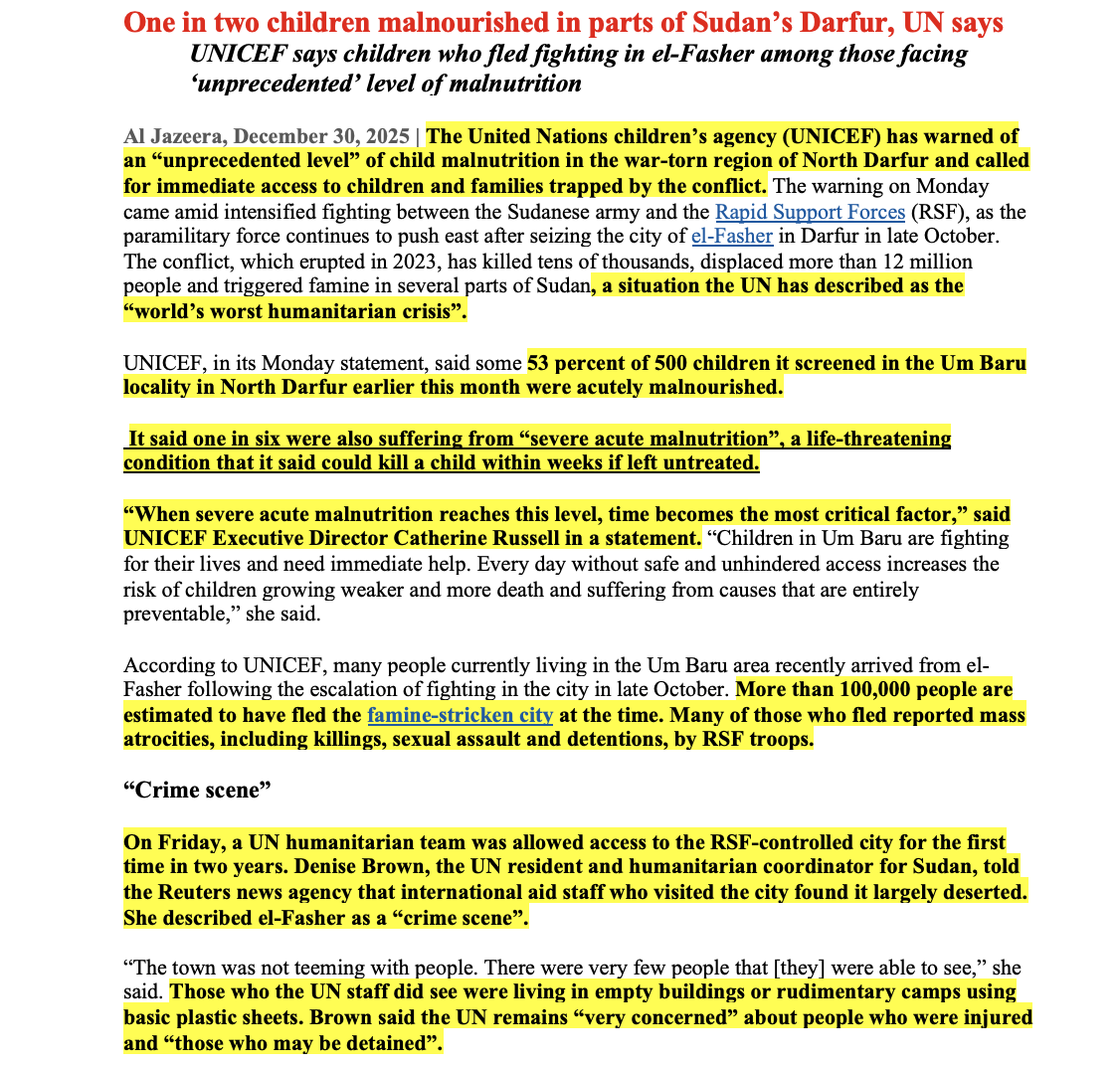
Rubio also gave an accurate account of RSF negotiating style: “I think the fundamental [negotiating] problem we have is that the RSF agrees to things and then never – never follows through with it.” But of course, the UAE could, if it were pressured to do so, secure RSF commitment to agreements: a cutoff of Emirati support would bring about the almost immediate collapse of the RSF militarily.
Neither Trump himself—or anyone in his administration—has held the UAE to account. The claim that “we’re going to start working in Sudan” has proved vacuous. Moreover, it is highly likely that Trump was unaware of the Emirati role in Sudan and was merely acquiescing before the blandishments of bin Salman. And given Trump’s unctuous words about UAE strongman Mohamed bin Zayed, and the massive mutual investment that was discussed in a presidential visit to the UAE last May, how likely is it that he would offend his recent host? (See below)
Notably, Trump’s words have brought no diplomatic coherence to peace efforts for Sudan. Failure is further ensured by the incompetence of his senior negotiator and Senior Adviser on African Affairs, Massad Boulos. Boulous seems to have as his main asset the fact that he is married to Trump’s daughter Tiffany. Incredibly, Boulos has no diplomatic experience to draw on; moreover he has no larger understanding of the many countries of Africa, and only a very shallow understanding of Sudanese history. His failures were assessed by The Guardian on December 5, 2025: https://www.theguardian.com/world/2025/dec/05/us-sanctions-sudan-army-rsf-ceasefire
And to be sure, matters are hardly helped when the African Union has yet again betrayed Sudan through diplomatic incompetence and incoherence (see appended headlines from today’s Sudan Tribune and Radio Dabanga).
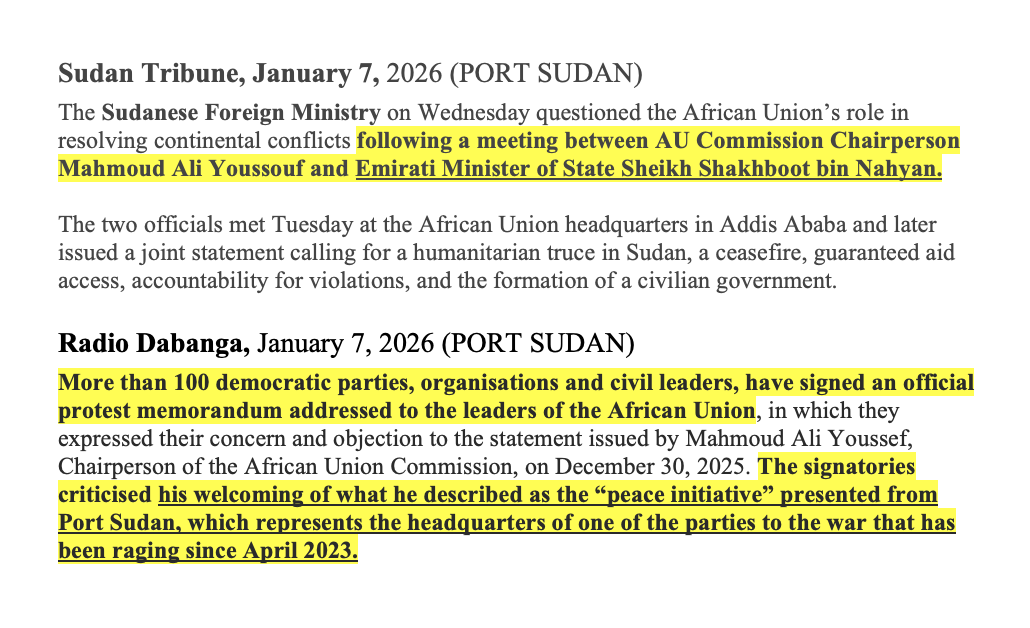
But let us make no mistake about it: the UAE is the essential player in any peace agreement—not by virtue of any constructive diplomatic role it is playing as a member of “the Quad,” but because it is for all intents and purposes one of the belligerents in a war that will end up costing hundreds of thousands of civilian lives—and entail in large measure the destruction of much of Sudan. The UAE has the petro-wealth to sustain the war indefinitely.
Trump’s refusal to call out the UAE makes clear just how little his putative commitment to Sudan means—and why the UAE, understanding full well the meaning of such refusal by all in the Trump administration, will continue to provide the RSF with all it needs militarily.
Why does Trump continue his administration’s refusal to call out the UAE and Mohamed bin Zayed?
“I have absolutely no doubt that the relationship will only get bigger and better,” Trump said in a meeting with UAE President Sheikh Mohamed bin Zayed Al Nahyan.
“It’s an honor to be here,” the president said. “And the last four days have been really amazing.”
“You are considered a truly great warrior, and you’ve been through the wars. You’re a great warrior, a very strong man, a brilliant man, a man of vision like few others—like few others—and highly respected. When they know you, there’s tremendous respect.”
“And you’re a magnificent man, and it’s an honor to be with you.”

And what sort of business partner does the relentlessly transactional Trump see in bin Zayed and the UAE?
During his May 2025 trip to the UAE, dreaming of claiming part of Emirati wealth, Trump declared:
• “The deal with UAE is expected to enable the Gulf country to build data centres vital to developing artificial intelligence models. The countries did not say which AI chips could be included in UAE data centres. Nvidia CEO Jensen Huang had earlier been seen in conversation with Sheikh Mohamed and Trump.
• “The AI agreement ‘includes the UAE committing to invest in, build, or finance U.S. data centres that are at least as large and as powerful as those in the UAE,’ the White House said.
• “Reporting from Doha in Qatar, Al Jazeera’s Hashem Ahelbarra said such a deal had been “a national security concern” for Washington in the past. “But then they decided to change their mind under Trump, particularly ***when the UAE said that it was willing to invest $1.4 trillion***” he said.
Ahelbarra said the deal was a “significant step” for the UAE, positioning it as “the most important player in artificial intelligence, followed by Saudi Arabia”.